
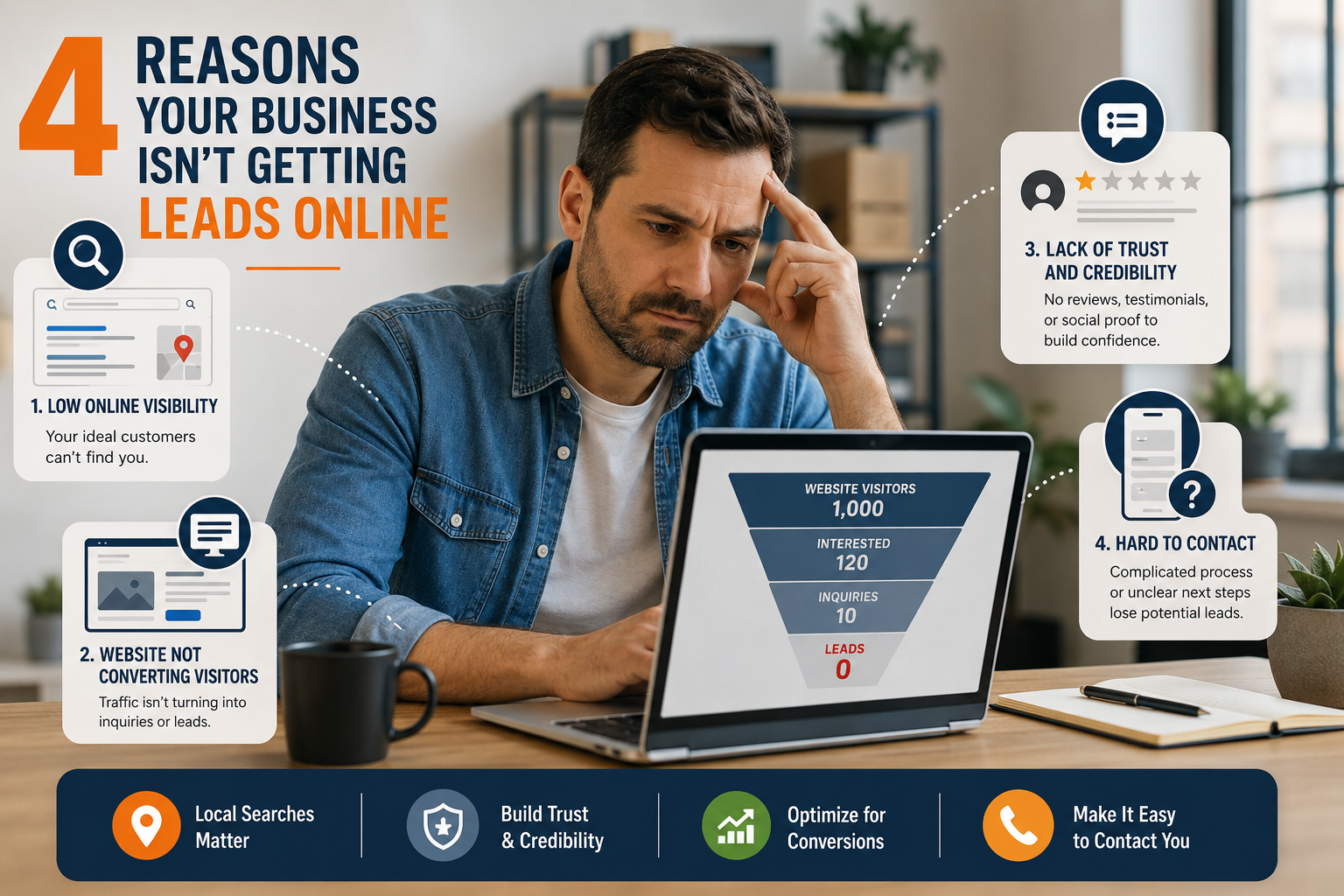
If your business isn’t getting leads online, you’re not alone. Many small-business owners invest in a website, social media, Google visibility, or online advertising but still struggle to generate consistent inquiries, calls, bookings, or quote requests.
The problem is often not that people are avoiding your business. More commonly, your online presence is failing at one of four critical stages: being found, earning attention, building trust, or making it easy to take action.
Understanding why your business isn’t getting leads online can help you stop wasting money on disconnected marketing tactics and build a system that consistently turns online visitors into potential customers.
In this guide, we’ll look at four common reasons your business isn’t getting leads online and what you can do to fix each one.
1. Your Business Isn’t Visible to the Right People
One of the biggest reasons a business isn’t getting leads online is simple: potential customers aren’t finding it.
You may have a professional website, attractive services, and years of experience, but none of that matters if your ideal customers can’t discover you when they search.
For local businesses, visibility is especially important because customers often use search engines to find businesses near them. Someone searching for a plumber, dentist, accountant, contractor, salon, photographer, or cleaning company usually wants a solution nearby and often wants it quickly.
Why isn’t my local business showing up in search results?
Your website may not be properly optimized for the searches your customers actually use.
For example, a landscaping company might want to rank for “landscaping company,” but customers may search for terms such as:
- landscaping company near me
- residential landscaping services
- lawn maintenance in [city]
- affordable landscaping services
- garden design services near me
- local landscaping contractor
These are examples of long-tail keywords that can attract people with a specific need.
Your Google Business Profile, website content, location pages, reviews, business information, and local SEO signals all contribute to your online visibility.
How can I improve local visibility?
Start by identifying the services you offer and the locations you serve. Then create useful content and website pages that clearly explain those services.
Make sure your business information is consistent across relevant online directories and platforms. Your website should also clearly communicate:
- What your business does
- Who you serve
- Where you operate
- What services you provide
- Why customers should choose you
- How customers can contact you
A strong local SEO strategy isn’t about adding your city name everywhere. It’s about making your business genuinely relevant to local searches.
2. Your Website Gets Traffic but Doesn’t Convert Visitors
Another common reason a business isn’t getting leads online is a website that attracts visitors but fails to convince them to take the next step.
Getting website traffic is only part of the process.
If 1,000 people visit your website but nobody calls, submits a form, requests a quote, or books an appointment, the traffic isn’t producing meaningful business results.
Why is my website getting visitors but no leads?
Visitors may leave without contacting you because your website doesn’t immediately answer their most important questions.
A potential customer wants to know:
Can you solve my problem?
Do you serve my area?
Can I trust you?
How much does your service cost or how can I get a quote?
What should I do next?
If your website makes those answers difficult to find, visitors have little reason to stay.
Your homepage should communicate your value proposition quickly. Instead of vague statements such as “Quality You Can Trust,” explain exactly what you provide and who you help.
For example:
“Residential Roofing Services for Homeowners in [City] — Request a Free Inspection.”
That statement is specific, relevant, and action-oriented.
What should a local business website include?
A lead-generating website should generally include:
- A clear headline
- Specific service information
- Local service areas
- Strong calls to action
- Phone and contact information
- Customer reviews or testimonials
- Relevant photographs or examples of work
- Frequently asked questions
- Clear next steps
- Mobile-friendly design
Your website doesn’t need to be complicated. It needs to make the customer’s decision easier.
3. Your Online Presence Doesn’t Build Enough Trust
People rarely contact a local business simply because it appears in search results.
They compare options.
Before contacting you, potential customers may look at your reviews, website, photos, social profiles, testimonials, service information, and overall reputation.
If your online presence doesn’t establish credibility, your business isn’t getting leads online because visitors aren’t confident enough to take action.
Why aren’t customers contacting my business online?
A lack of trust signals could be the problem.
Imagine someone searches for “AC repair near me” and finds two companies.
The first company has:
- Hundreds of recent reviews
- Detailed service information
- Photos of completed work
- A professional website
- Clear contact information
- Customer testimonials
The second company has:
- An outdated website
- Few reviews
- Little service information
- No recent photographs
- No obvious way to request service
Even if both companies provide excellent work, the first business is likely to receive more inquiries.
How do online reviews help generate leads?
Reviews provide social proof.
Potential customers want evidence that other people have had positive experiences with your business. That’s why actively collecting genuine customer reviews can support both trust and local search visibility.
However, don’t rely exclusively on reviews.
Build trust throughout your website by showing real examples of your work, explaining your process, introducing your team, highlighting relevant experience, and answering common customer questions.
For a local business, authenticity can be more persuasive than polished marketing language.
4. You’re Making It Too Difficult to Contact You
Sometimes the reason a business isn’t getting leads online has nothing to do with visibility or traffic.
The problem is friction.
A potential customer may be ready to contact you, but if the process is complicated, they may simply move on.
How can I make my website generate more leads?
Give visitors multiple simple ways to contact your business.
Depending on your industry, these could include:
- Call Now
- Request a Quote
- Book an Appointment
- Get a Free Consultation
- Send an Inquiry
- Schedule a Service
Your primary call to action should be easy to find.
Don’t make customers search through your website for your phone number. Don’t bury your contact form on a page that takes several clicks to reach.
For mobile users, this is https://digigyapan.inparticularly important.
Someone searching for a local service from their phone may want to contact you immediately. A difficult mobile experience can turn an interested prospect into a lost opportunity.
What is the best call to action for a local business?
The answer depends on what customers need to do before purchasing.
A service business may benefit from “Request a Quote.”
A professional consultant may use “Book a Consultation.”
A medical practice may use “Schedule an Appointment.”
A restaurant may use “Reserve a Table.”
The best CTA is specific to the customer’s next logical step.
Instead of simply saying “Learn More,” tell visitors exactly what they can do.
How to Fix a Business That Isn’t Getting Leads Online
If your business isn’t getting leads online, don’t immediately assume you need to spend more money on advertising.
First, examine your existing customer journey.
Ask these four questions:
Can customers find my business online?
Check whether your website and local listings appear for relevant searches in your service area.
Does my website explain what I offer?
Make sure your services, locations, benefits, and value proposition are easy to understand.
Does my online presence build trust?
Look for genuine reviews, testimonials, photographs, case studies, credentials, and other evidence that supports your claims.
Is it easy to contact me?
Test your website on a phone. Can someone find your phone number, contact form, booking option, or quote request within seconds?
If the answer to one or more questions is no, you may have identified the reason your business isn’t getting leads online.
Don’t Focus Only on Getting More Traffic
A common mistake among small-business owners is assuming that more website visitors automatically mean more customers.
It doesn’t.
A successful online marketing strategy connects several stages:
Visibility → Website Traffic → Trust → Conversion → Lead → Customer
If one stage is broken, increasing activity at another stage may not solve the problem.
For example, if your website https://digigyapan.inreceives traffic but has no clear call to action, buying more traffic could simply increase the number of people who leave without contacting you.
Likewise, if your business has a strong website but doesn’t appear in local search results, improving the website alone may not generate enough visitors.
The goal isn’t simply to get more clicks.
The goal is to attract the right potential https://digigyapan.incustomers and give them a clear reason to contact you.
Frequently Asked Questions
Why isn’t my small business getting leads online?
A small business may struggle to generate online leads because it isn’t visible in relevant searches, has a weak website conversion process, lacks trust signals, or makes contacting the business difficult. Start by identifying where potential customers are dropping out of the journey.
How do I get more leads for my local business?
Improve local search visibility, create useful service-focused website content, build genuine customer reviews, optimize your website for conversions, and provide clear calls to action. Consistency across these areas is more effective than relying on a single marketing channel.
Why is my website not generating leads?
Your website may not clearly communicate your services, target customers, service area, credibility, or next step. Review your headlines, service pages, testimonials, contact options, mobile experience, and calls to action.
How long does local SEO take to generate leads?
Results vary based on competition, location, website quality, existing authority, and the search terms being targeted. Local SEO is generally a long-term strategy, so businesses should measure progress through visibility, relevant traffic, inquiries, calls, and conversions rather than expecting immediate results.
What are the best long-tail keywords for local businesses?
Useful long-tail keywords often describe a specific service, location, or customer need. Examples include “best [service] near me,” “[service] in [city],” “affordable [service] near me,” and “professional [service] for [customer type].” The best keywords depend on your specific business and customers.
Should I invest in SEO or online advertising?
It depends on your goals, competition, budget, and timeframe. SEO can build long-term organic visibility, while advertising can generate targeted traffic more quickly. Many businesses benefit from combining both approaches rather than relying exclusively on one channel.
How can I tell why my business isn’t getting leads online?
Review your online marketing funnel from beginning to end. Check whether customers can find you, whether your website answers their questions, whether your business appears trustworthy, and whether contacting you is easy. Analytics, search performance data, call tracking, and conversion tracking can help identify the biggest bottleneck.
Final Takeaway
If your business isn’t getting leads online, the solution may not be “more marketing.”
You may need better visibility, stronger messaging, more trust, or a simpler conversion process.
Start by identifying where your potential customers are getting stuck. Then fix that specific problem before investing more heavily in traffic or advertising.
For local small businesses, online lead generation works best when every part of the customer journey supports the next: customers should be able to find your business, understand your offer, trust your business, and contact you easily.
Fix those four areas, and your online presence has a much better chance of turning searches and website visits into real business opportunities.