
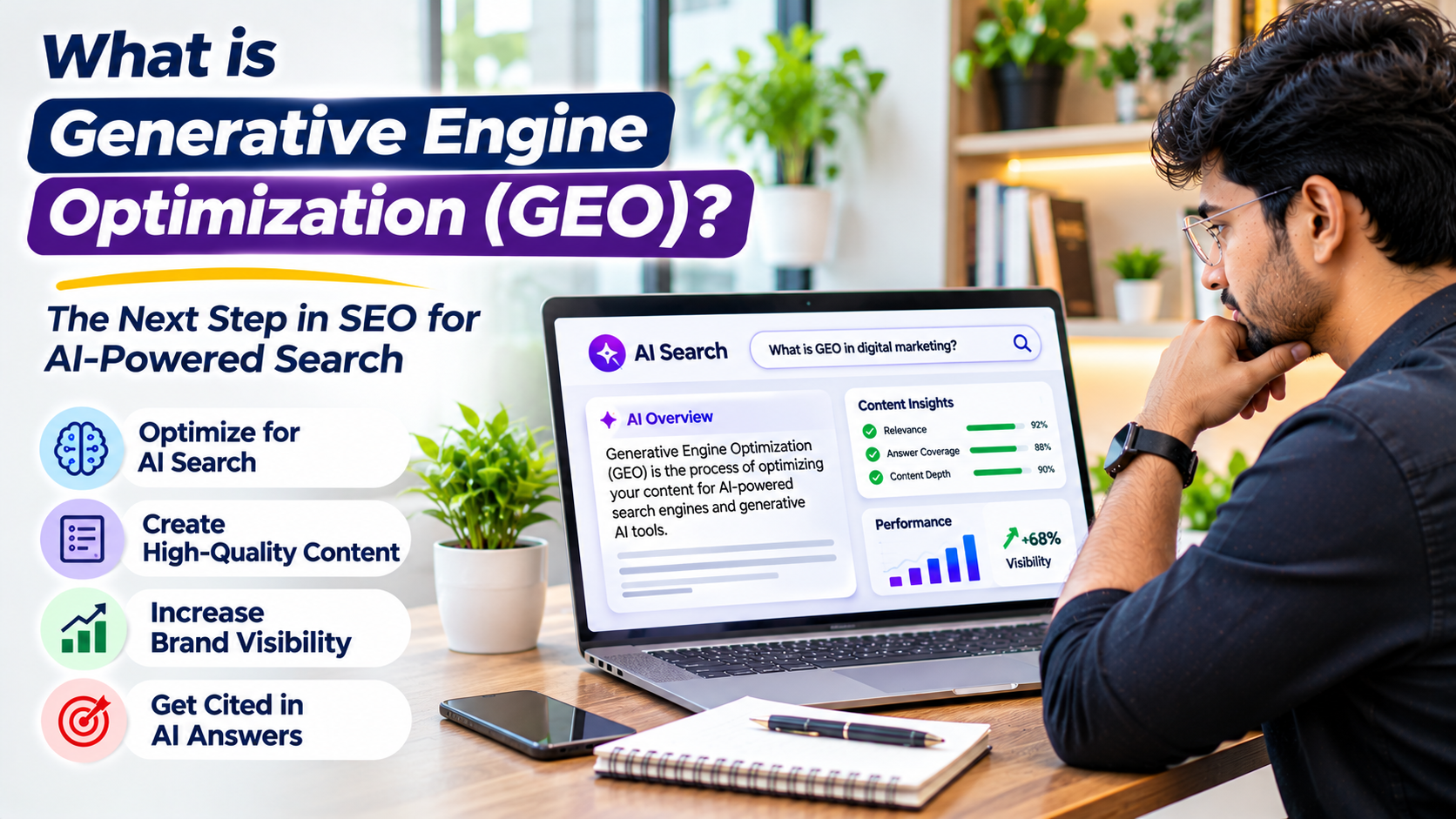
Search engines are changing how people discover information online. Traditionally, users entered a query into Google, reviewed a list of websites, and clicked a page to find an answer. Today, AI-powered tools such as ChatGPT, Google AI Overviews, and Perplexity can provide summarized answers, recommendations, and explanations directly within the search experience.
This shift has introduced a new area of digital marketing called Generative Engine Optimization (GEO). GEO focuses on making website content easier for AI-powered search and answer engines to discover, understand, and potentially reference when generating responses.
For businesses in Sonipat and surrounding areas, understanding generative engine optimization can help prepare their websites for evolving search behavior. Whether your business operates in Model Town Sonipat, Sector 14 Sonipat, Murthal, Ganaur, Gohana, or Kharkhoda, creating useful and well-structured content can strengthen your online visibility across traditional and AI-powered search experiences.
This beginner’s guide explains what GEO is, how it works, why it matters, and how businesses can begin optimizing their content.
What Is Generative Engine Optimization (GEO)?
Generative Engine Optimization is the practice of improving digital content so that AI-powered search engines and answer engines can understand, evaluate, and potentially use it when generating responses to user queries.
Unlike traditional search engines, which commonly present a list of links, generative engines may synthesize information from multiple sources and provide a conversational answer. Depending on the platform and query, they may also include links or citations to the sources they used.
GEO aims to make your content:
- Clear and easy for AI systems to interpret.
- Relevant to the questions people ask.
- Accurate, trustworthy, and supported by useful information.
- Well organized with descriptive headings.
- Accessible to search crawlers and other discovery systems.
- Distinctive enough to offer value beyond existing sources.
GEO is not a guaranteed method for appearing in AI-generated answers. AI systems select and present information using different methods, and their results can change. However, publishing helpful, accessible, and authoritative content can improve your chances of being discovered and considered.
How Does GEO Differ From Traditional SEO?
Generative Engine Optimization and Search Engine Optimization share many principles, but they focus on different aspects of online discovery.
Traditional SEO primarily aims to improve a website’s visibility in search engine results pages. GEO focuses on helping content become understandable and useful to generative systems that may create answers from multiple sources.
| Traditional SEO | Generative Engine Optimization |
|---|---|
| Focuses on visibility in search results | Focuses on visibility and potential inclusion in AI-generated answers |
| Optimizes pages for relevant search queries | Organizes information to answer natural-language questions |
| Uses titles, headings, links, and technical optimization | Uses clear structure, direct answers, context, and trustworthy information |
| Measures rankings, clicks, impressions, and organic traffic | May also measure AI citations, mentions, referral visits, and answer visibility |
| Often targets specific keywords | Also considers conversational questions and related concepts |
These approaches are not mutually exclusive. A well-optimized website can support both traditional search and AI-powered discovery.
Why Is Generative Engine Optimization Important?
People increasingly use AI tools to research products, compare services, understand complex topics, and find recommendations. As these tools become part of the discovery process, businesses may benefit from making their content accessible and useful to AI-powered systems.
GEO can support several business objectives.
1. Reach Audiences Through New Discovery Channels
Potential customers may discover a business through an AI-generated answer rather than by clicking a traditional search result.
For example, someone might ask an AI assistant to recommend digital marketing services for a business in Sonipat. If the assistant uses relevant, accessible information from your website, your business may have an opportunity to appear in the response.
2. Build Brand Awareness
Being referenced in an AI-generated answer can introduce your brand to people who may not have encountered it otherwise.
Even when a user does not immediately visit your website, an accurate brand mention may help them recognize your business later.
3. Provide Helpful Answers to Customer Questions
GEO encourages businesses to organize information around real customer needs. This can make it easier for users to understand services, compare options, and make informed decisions.
4. Prepare for Evolving Search Behavior
Search interfaces and user habits continue to develop. Businesses that maintain useful, technically accessible, and well-organized content can adapt more easily as new discovery experiences emerge.
How Do Generative Search Engines Find and Use Content?
AI-powered search and answer engines do not all work in the same way. Some systems retrieve information from web sources and use language models to generate responses. Others may rely on different combinations of search indexes, model knowledge, and retrieval systems.
A simplified process may include the following steps:
- Understand the question: The system interprets the user’s query and identifies the information needed.
- Retrieve relevant sources: Depending on the platform, it may search an index or retrieve relevant documents.
- Evaluate information: It may consider relevance, clarity, authority, freshness, and other signals.
- Generate a response: The model synthesizes information into a natural-language answer.
- Provide references: Some platforms display citations or links to selected sources.
This process varies by platform and query. There is no universal GEO ranking formula that guarantees a website will be cited.
1. Create Helpful, People-First Content
The foundation of GEO is content that genuinely helps readers.
AI systems may be able to summarize generic information from many sources. Content that provides clear explanations, original insights, practical steps, or relevant examples offers stronger value to readers.
To create useful content:
- Answer the main question early.
- Explain concepts in simple language.
- Include practical examples and actionable steps.
- Support important claims with reliable evidence.
- Keep information accurate and up to date.
- Avoid unnecessary repetition and filler.
- Add original perspectives when you have relevant experience.
For example, a digital marketing agency in Sonipat could publish a guide explaining how local businesses can improve their online visibility. Rather than repeating generic SEO advice, the article could discuss realistic challenges faced by local service providers and provide practical recommendations.
2. Answer Specific Questions Clearly
Many people interact with AI tools using complete questions rather than short keyword phrases.
Examples include:
- What is generative engine optimization?
- How does GEO differ from SEO?
- How can a small business improve its visibility in AI search?
- Does GEO replace traditional SEO?
- How can a website measure AI search visibility?
Create content that answers relevant questions directly. A useful structure is to introduce the question as a heading and provide a concise answer in the first paragraph, followed by supporting details.
This makes the information easier for readers to scan and easier for automated systems to interpret.
3. Use Clear Headings and Logical Structure
Well-organized content helps readers navigate a page and understand the relationship between ideas.
Use:
- One clear H1 heading for the main topic.
- H2 headings for major sections.
- H3 headings for supporting subsections.
- Short paragraphs and descriptive lists.
- Tables when they make comparisons easier.
Avoid vague headings such as “More Information” or “Things to Know.” Specific headings provide better context.
For example:
H2: How Can Small Businesses Improve GEO?
H3: Create Helpful Local Business Content
A clear structure supports readability and helps identify the key information on a page.
4. Include Relevant Facts and Context
Generative systems need context to interpret information correctly. Make sure your content clearly identifies the people, businesses, services, locations, and concepts it discusses.
For a business website, useful information may include:
- The business name and what it does.
- The services or products offered.
- The areas it serves.
- Relevant qualifications or experience.
- Contact and business information.
- Clear explanations of processes and service benefits.
Keep business details consistent across your website and relevant online profiles. Do not publish unsupported claims, fabricated statistics, or misleading credentials.
5. Demonstrate Experience and Trustworthiness
Trust matters when people rely on content to make decisions. A website should make it clear why its information deserves attention.
Ways to strengthen credibility include:
- Publishing accurate author or business information.
- Providing relevant professional experience.
- Citing reliable sources for factual claims.
- Updating outdated information.
- Using real examples when permission and accuracy allow.
- Avoiding exaggerated guarantees.
- Maintaining clear contact and business details.
For topics involving health, finance, or other important decisions, use reliable sources and ensure the information is reviewed appropriately.
6. Use Structured Data Where Appropriate
Structured data is a standardized way to describe information on a webpage. It can help search engines interpret details about a page, organization, product, service, or other entity.
Depending on the content, relevant schema types may include:
- Organization
- LocalBusiness
- Article
- BreadcrumbList
- Product
- Service
Use structured data that accurately reflects visible page content and follows the relevant search engine guidelines.
Structured data does not guarantee that your content will appear in AI-generated answers. It is one part of making information easier for systems to interpret.
7. Strengthen Your Website’s Technical Accessibility
Content cannot be discovered reliably if important pages are inaccessible to search crawlers.
Review the following technical factors:
- Ensure important pages can be crawled.
- Avoid unintentionally blocking relevant content in robots.txt.
- Check that pages return the correct HTTP status codes.
- Use XML sitemaps to help search engines discover important URLs.
- Fix broken internal links.
- Use canonical tags appropriately.
- Make sure important content is available in crawlable HTML.
- Provide a mobile-friendly experience.
- Monitor loading performance and usability.
Google Search Console can help identify indexing issues and show how your pages perform in Google Search. Technical accessibility is important for search discovery, although different AI platforms may have their own crawling and access requirements.
8. Build Relevant Internal and External Links
Links help establish relationships between information and guide readers toward additional resources.
Internal Links
Link related pages on your website using descriptive anchor text. For example, an article about GEO may link to relevant pages about SEO services, content marketing, keyword research, or website optimization.
Internal links help readers explore related topics and provide context about your website’s content.
External Links
Reference trustworthy sources when they support important claims or provide additional information.
Avoid adding irrelevant links or using manipulative link schemes. The goal is to help readers verify information and explore useful resources.
9. Optimize Content for Local Search and GEO
Local businesses can use GEO principles to make their service information clearer and more relevant to nearby audiences.
For businesses serving Sonipat and the surrounding region, location-specific content may include relevant references to Model Town Sonipat, Sector 7, Sector 14, Sector 15, Murthal, Ganaur, Gohana, Kharkhoda, and other service areas.
Useful local content can explain:
- Which services the business provides.
- Which locations it serves.
- How customers can contact or visit the business.
- What customers should consider before choosing a provider.
- Answers to common questions from local customers.
Avoid creating multiple pages that simply replace one location name with another. Each location page should provide genuinely useful and distinct information.
10. Measure GEO Performance
GEO measurement is still developing, and there is no single universally accepted metric for AI visibility.
Businesses can monitor a combination of indicators:
AI Mentions and Citations
Check whether relevant AI-powered tools mention your business or reference your website when answering questions related to your services.
Because responses can vary by query, platform, location, and time, treat individual observations cautiously.
Referral Traffic
Review website analytics for visits from AI platforms and other referral sources. Referral traffic can show whether AI-powered discovery is sending visitors to your website.
Organic Search Performance
Continue monitoring traditional SEO metrics, including impressions, clicks, CTR, rankings, and conversions. Strong organic performance can complement GEO efforts.
Engagement and Conversions
Evaluate whether visitors who arrive through search or referral channels engage with your content, contact your business, or complete relevant actions.
Use these measurements together rather than relying on a single AI mention or ranking snapshot.
Common GEO Mistakes to Avoid
Avoid these practices when optimizing content for generative engines:
- Keyword stuffing: Repeating keywords unnaturally reduces readability.
- Publishing generic content: Content that adds no useful information offers little value.
- Making unsupported claims: Unverified facts can damage credibility.
- Creating location doorway pages: Repetitive pages with minimal differences can provide a poor user experience.
- Ignoring technical SEO: Important content must be accessible to discovery systems.
- Using misleading structured data: Markup should accurately represent visible content.
- Expecting guaranteed AI citations: No legitimate GEO technique can guarantee inclusion in generated answers.
- Abandoning traditional SEO: GEO complements rather than replaces a strong SEO foundation.
GEO Checklist for Beginners
Before publishing or updating a page, review this checklist:
- The content answers a clear user question.
- The primary topic and related concepts are explained.
- The introduction provides a direct, useful answer.
- Headings follow a logical structure.
- Information is accurate, original, and relevant.
- Important claims are supported by reliable sources.
- Business and location details are clear and consistent.
- Internal and external links add value.
- Relevant structured data is implemented correctly.
- Important pages are technically accessible.
- The page works well on mobile devices.
- Performance and engagement are monitored after publication.
Conclusion
Generative Engine Optimization is an evolving approach to improving how content is discovered and understood by AI-powered search and answer engines. It emphasizes helpful information, clear structure, accurate context, technical accessibility, and trust.
For businesses in Sonipat, Model Town Sonipat, Murthal, Ganaur, Gohana, Kharkhoda, and the wider Delhi NCR region, GEO can complement traditional SEO by helping make website content more useful across different search experiences.
There is no guaranteed shortcut to AI visibility. The most sustainable approach is to publish content that answers real questions, maintain a technically accessible website, and continually improve information based on user needs and performance data.
Businesses seeking support with SEO, content strategy, and online visibility can explore digital marketing services from Digigyapan to develop a structured approach to improving their website presence.