
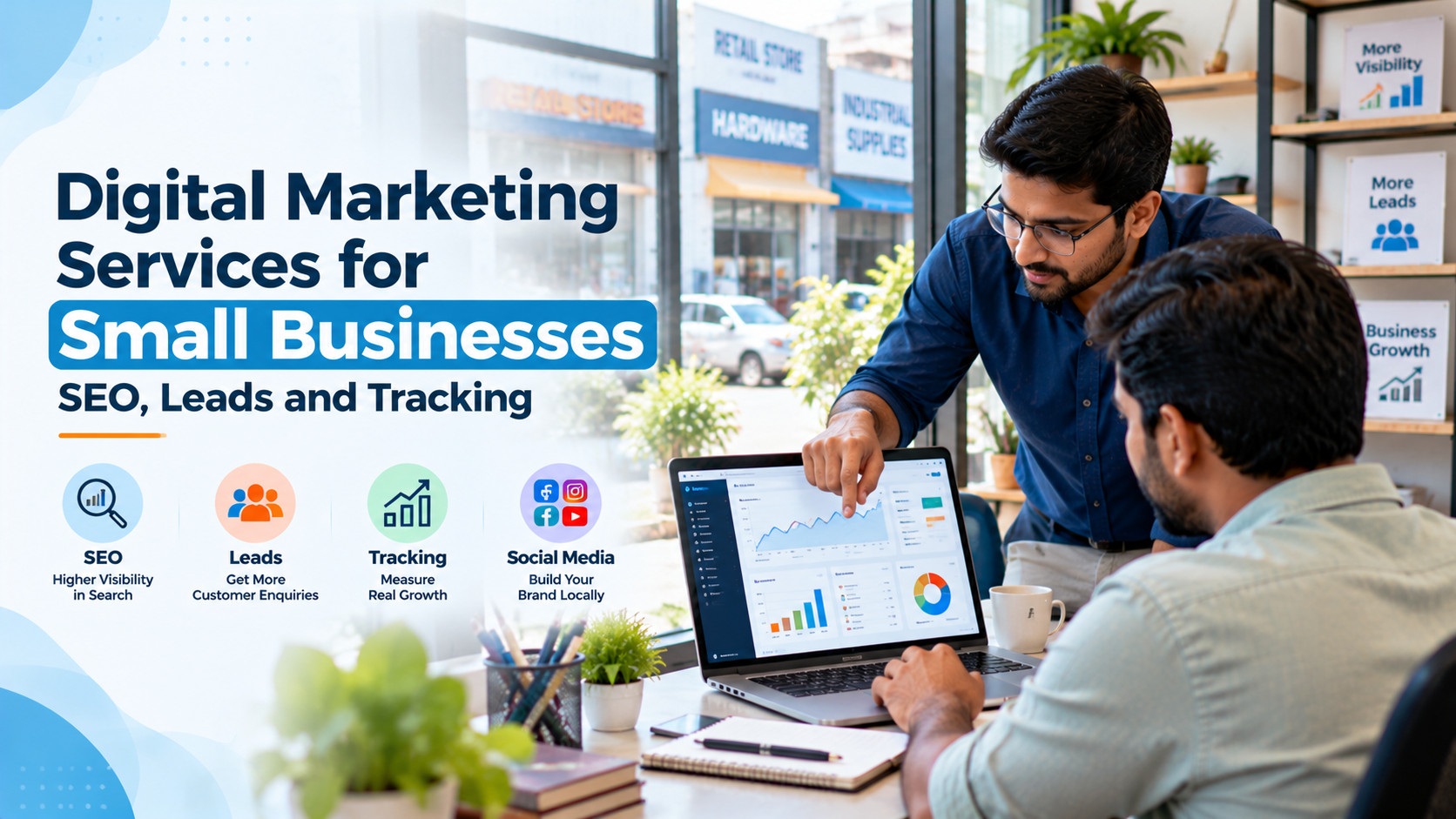
Running a small business is not easy. You need to find new customers, build trust, manage daily operations, and increase sales without wasting your marketing budget. This is where digital marketing services for small businesses can make a real difference.
Whether you own a shop in Model Town, run a service business in Sector 14, manage an industrial unit in Kundli, or operate a company near Rai Industrial Area, your customers are already using Google, social media, and online platforms to find products and services.
The right digital marketing strategy helps your business reach these potential customers, generate relevant enquiries, and understand which marketing activities are producing results.
At Digigyapan, we help businesses strengthen their online presence through social media marketing, Google services, website design, and related digital marketing solutions. Our goal is to help businesses build a stronger digital presence and connect with their target audience.
In this guide, you will learn how SEO, lead generation, social media marketing, Google Ads, website optimization, and conversion tracking work together to support small-business growth.
What Are Digital Marketing Services for Small Businesses?
Digital marketing services help businesses promote their products or services through online channels. Instead of relying only on traditional advertising, businesses can use search engines, websites, social media, and paid advertisements to connect with people who may need their offerings.
For small businesses, digital marketing is not simply about getting more website visitors. It is about attracting the right audience and turning that attention into enquiries, appointments, calls, and sales.
Common digital marketing services include:
- Search engine optimization (SEO)
- Local SEO and Google Business Profile optimization
- Social media marketing
- Google Ads and paid search advertising
- Website design and optimization
- Content marketing
- Lead generation campaigns
- Marketing analytics and conversion tracking
The best combination depends on your business type, target customers, competition, and budget.
For example, a local salon may benefit from local SEO and social media marketing, while a manufacturer in an industrial area may need a professional website, search advertising, and a system for tracking business enquiries.
Why Do Small Businesses Need Digital Marketing?
Many potential customers search online before contacting a business. They compare services, check reviews, explore websites, and look for contact details before deciding whom to approach.
If your business is difficult to find online, you may miss opportunities to connect with those customers.
Here are some important benefits of digital marketing for small businesses.
1. Reach Customers Who Are Already Searching
SEO and Google Ads can help your business appear when people search for relevant products or services. The aim is to reach users whose needs match what your business offers.
2. Build Trust Before the First Conversation
A clear website, useful content, consistent social media activity, and an accurate business profile can help potential customers understand your business before they contact you.
3. Generate More Relevant Enquiries
Lead generation campaigns encourage interested people to call, fill out a form, request a quotation, book an appointment, or send a message.
4. Make Better Use of Your Marketing Budget
Marketing analytics helps you understand which channels attract visitors and generate enquiries. This information makes it easier to review campaigns and improve your spending decisions.
5. Compete in Your Local Market
A small business does not always need to target an entire state or country. Reaching relevant customers in specific neighbourhoods, towns, and industrial areas can be a practical starting point.
SEO Services: Help Customers Find Your Business on Google
Search engine optimization, commonly known as SEO, improves your website’s ability to be discovered through relevant organic search results.
Unlike paid advertising, organic search visibility does not require paying for every click. However, SEO requires ongoing work, and rankings or traffic growth are never guaranteed.
For small businesses, a useful SEO strategy usually includes technical improvements, relevant content, local search optimization, and a website experience that helps visitors take the next step.
What Are the Most Important SEO Services for Small Businesses?
Keyword research: Identify the phrases potential customers use when searching for your products or services.
On-page SEO: Improve page titles, headings, descriptions, content, images, and internal links.
Technical SEO: Help search engines discover and understand your website by addressing issues such as broken links, indexing problems, and poor mobile performance.
Local SEO: Improve your visibility for relevant location-based searches and maintain accurate business information online.
Content optimization: Create useful service pages, blog posts, and FAQs that answer real customer questions.
Performance monitoring: Review search impressions, clicks, landing pages, and enquiries to understand how your SEO work is performing.
How Can Local SEO Help Businesses in Sonipat?
Local SEO helps businesses become more visible to customers searching for relevant services in a particular area.
For example, a customer may search for a digital marketing agency in Sonipat, website design services near Kundli, or SEO services for a business in Kharkhoda.
To improve local search visibility, businesses should focus on:
- Creating and maintaining an accurate Google Business Profile when eligible.
- Keeping business name, address, phone number, and opening hours consistent.
- Building useful, location-relevant website content.
- Collecting genuine customer reviews without incentives or manipulation.
- Ensuring the website works well on mobile devices.
- Providing clear service descriptions and contact options.
Businesses serving customers across Sonipat, Ganaur, Gohana, Murthal, Bahadurgarh, Rohtak, and nearby industrial areas should prioritize locations they genuinely serve.
Avoid creating large numbers of nearly identical location pages with only the town name changed. Each location page should provide real value to customers in that area.
Lead Generation: Turn Online Visitors Into Business Enquiries
Getting traffic is only one part of digital marketing. Your website also needs to help interested visitors become potential customers.
Lead generation is the process of attracting people who may be interested in your products or services and encouraging them to share their contact details or reach out to your business.
Depending on your business, a lead might be a phone call, quotation request, consultation booking, contact form submission, or WhatsApp enquiry.
What Are Effective Lead Generation Strategies for Small Businesses?
1. Create focused landing pages
A landing page should explain one service, who it is for, what problem it solves, and how the visitor can contact you.
For example, a manufacturer may need a dedicated page for a particular industrial product instead of sending every visitor to a general homepage.
2. Add clear calls to action
Use straightforward instructions such as “Request a Quote,” “Call Our Team,” or “Discuss Your Requirements.”
Make sure each action works correctly on both desktop and mobile devices.
3. Offer useful information
Helpful guides, product specifications, service explanations, and pricing information can help potential customers make informed decisions.
4. Respond to enquiries promptly
A marketing campaign cannot deliver its full value if enquiries remain unanswered. Establish a process for assigning, following up on, and recording leads.
5. Measure lead quality
Not every enquiry will become a customer. Track which leads match your target audience, which progress to sales conversations, and which eventually become paying customers.
A campaign that generates fewer but more relevant enquiries may be more valuable than one that produces a high volume of unqualified leads.
Social Media Marketing: Build Awareness and Customer Relationships
Social media marketing helps small businesses share information, communicate with customers, showcase their work, and stay visible to their audience.
The right platform depends on your customers and business model. A consumer-facing business may benefit from visual content on Instagram and Facebook, while a B2B company may find LinkedIn useful for reaching professional decision-makers.
How Can Small Businesses Use Social Media Marketing Effectively?
Start with a practical plan instead of trying to post everywhere.
- Share helpful information related to your products or services.
- Publish genuine photos, demonstrations, and project updates.
- Answer common customer questions.
- Highlight real customer feedback with permission.
- Share educational videos and useful tips.
- Include clear next steps when appropriate.
- Review which posts generate meaningful conversations and enquiries.
Consistency and relevance matter more than posting simply to fill a content calendar.
Social media can also support other marketing channels. For example, a potential customer might discover your business through a social post, visit your website later, and eventually contact you after a Google search.
Google Ads: Reach Potential Customers Through Paid Search
Google Ads allows businesses to advertise for relevant searches and other placements across Google’s advertising network.
For small businesses, paid search can be useful when you want to promote a specific service, reach customers actively searching for a solution, or test demand while building organic visibility.
However, advertising costs can add up if campaigns target the wrong searches or send visitors to an ineffective landing page.
How Can Small Businesses Get Better Results From Google Ads?
Choose relevant keywords. Focus on search terms that match your actual services and customer needs.
Use location targeting carefully. Select the areas you genuinely serve, and review the campaign’s location settings.
Write clear advertisements. Explain the service, key benefit, and next step without making unsupported promises.
Build relevant landing pages. The page should closely match the advertisement and make contacting your business easy.
Track conversions. Measure valuable actions such as completed forms, qualified calls, and quotation requests.
Review search terms and spending. Exclude irrelevant searches where appropriate and review performance regularly.
Remember that advertising clicks are not the same as qualified leads or sales. Evaluate campaigns according to business outcomes, not just traffic volume.
Website Optimization: Make It Easier for Visitors to Contact You
Your website is often where potential customers decide whether to take the next step. A website that loads slowly, looks confusing on mobile, or hides contact details can lose valuable opportunities.
Website optimization improves the experience for both visitors and search engines.
What Should a Small-Business Website Include?
A practical business website should include:
- A clear explanation of what your business does.
- Dedicated pages for important products or services.
- Relevant information about the company and its experience.
- Easy-to-find contact details.
- A visible phone number or appropriate enquiry option.
- Simple forms that request only necessary information.
- Customer reviews or case studies where genuine and available.
- Mobile-friendly layouts and readable text.
- Secure browsing and reliable website functionality.
- Clear privacy information when collecting personal details.
You should also review page speed, broken links, mobile usability, and the performance of important landing pages.
The purpose is simple: help visitors understand your offer and contact your business with as little friction as possible.
Marketing Analytics: Understand What Is Working
Marketing analytics helps businesses evaluate their digital marketing activity using measurable information.
Without tracking, it can be difficult to tell whether an increase in enquiries came from SEO, paid advertising, social media, referrals, or another source.
Useful tools may include Google Analytics, Google Search Console, advertising-platform reports, and a customer relationship management system.
The right setup depends on your website, marketing channels, and the actions you want customers to take.
Which Digital Marketing Metrics Should Small Businesses Track?
Website traffic: Understand how many people visit your website and which pages attract attention.
Search performance: Review organic impressions, clicks, search queries, and landing pages.
Enquiries and conversions: Count completed forms, calls, bookings, or other meaningful actions.
Cost per lead: Divide the relevant advertising spend by the number of leads attributed to that campaign.
Lead quality: Evaluate how many enquiries match your target customer profile.
Lead-to-customer rate: Measure the proportion of leads that become paying customers.
Return on advertising spend: Compare attributable revenue with advertising spend, while recognizing that this measure does not account for every business cost.
These metrics help you move beyond vanity numbers and focus on the outcomes that matter to your business.
Conversion Tracking: Connect Marketing Activity With Real Results
Conversion tracking records specific actions that matter to your business. These actions may include a completed enquiry form, a purchase, a booking, or a call generated through an advertising campaign.
When configured correctly, conversion tracking helps you understand which campaigns and channels contribute to customer actions.
How Does Conversion Tracking Work?
A typical conversion tracking setup follows these steps:
- Define the conversion. Decide which actions represent genuine business value.
- Configure the measurement tools. Set up the appropriate analytics events, advertising tags, or call tracking.
- Test the tracking. Confirm that the intended action is recorded once and that duplicate or accidental events are not inflating results.
- Review the reports. Compare campaigns, landing pages, and traffic sources.
- Improve the strategy. Use the results to make informed changes to budgets, content, and landing pages.
For example, suppose a Google Ads campaign receives 200 clicks and produces 10 recorded enquiries. The basic cost-per-enquiry calculation is:
Cost per enquiry = Advertising spend ÷ Recorded enquiries
If the campaign spends ₹5,000 and produces 10 enquiries, the cost per enquiry is ₹500.
This is an illustrative calculation, not a performance promise. You would still need to assess the quality of the enquiries and how many eventually become customers.
Tracking should also respect applicable privacy requirements and consent choices. Avoid collecting unnecessary personal information, and verify that the measurement setup works as intended.
How Do SEO, Lead Generation, and Tracking Work Together?
These services are most useful when they support a shared business goal rather than operating as separate activities.
Consider a local service business that wants more enquiries.
Step 1: SEO attracts relevant visitors. The business improves its service pages and local search presence so potential customers can discover it.
Step 2: The website encourages action. Visitors find clear information, understand the service, and can submit an enquiry or call.
Step 3: Lead generation captures interest. Contact forms, calls, or appropriate landing pages turn some visits into enquiries.
Step 4: Conversion tracking measures results. Analytics and campaign reports help identify which channels contribute to recorded actions.
Step 5: The business improves its marketing. The owner reviews lead quality, follows up with prospects, and adjusts the strategy based on the available evidence.
This approach creates a clearer connection between marketing activity and business growth.
Digital Marketing Services for Small Businesses in Sonipat and Nearby Areas
Local businesses often serve customers across more than one neighbourhood or town. A focused digital marketing strategy can help them reach relevant audiences without spreading resources too thinly.
Digigyapan is based in Sonipat, Haryana, and provides digital marketing-related services including social media marketing, Google services, and website design.
Businesses can develop location-focused strategies for the areas they genuinely serve, including:
- Sonipat city: Model Town, Sectors 7, 8, 12, 14, 15, 16, 17, 23, 27 and 30, along with Sikka Colony, Patel Nagar, Atlas Road, Old Chowk and Subhash Chowk.
- Nearby towns and commercial areas: Kharkhoda, Ganaur, Gohana, Murthal, Bahadurgarh, Sampla and Rohtak.
- Industrial and business locations: IMT Kharkhoda, Rai Industrial Area, Kundli, Barhi Industrial Area, Narela and Bawana.
- Nearby villages and surrounding communities: Sisana, Garhi Sisana, Rohna, Farmana, Barona, Jataula, Jharaut, Kundal, Nahra, Nahri, Rathdhana, Kami, Kakroi, Bajana Kalan, Tajpur, Pipli Khera, Purkhas, Ridhau, Rai Village, Jakhauli and Khewra.
The best location strategy depends on your actual service coverage, competition, and customer demand. You do not need a separate page for every area. Start with useful pages for your main services and priority locations, then expand when you have meaningful information to offer each audience.
How to Choose the Right Digital Marketing Services for Your Business
Not every small business needs every service immediately. Start with your biggest challenge and build a plan around it.
If customers cannot find you online: Start by reviewing local SEO, website indexing, your business profile, and your service pages.
If your website gets visitors but few enquiries: Review your landing pages, contact options, messaging, mobile experience, and conversion tracking.
If you need enquiries sooner: Consider a carefully targeted paid advertising campaign with a defined budget and a clear measurement plan.
If customers do not know your brand: Develop a consistent social media and content strategy that helps your audience understand your business.
If you receive enquiries but few sales: Review lead quality, response time, follow-up processes, and how well your offer matches customer needs.
A good digital marketing plan should identify the priority, explain the recommended activities, define measurable goals, and establish how results will be reviewed.
Why Consider Digigyapan for Your Digital Marketing Needs?
Choosing a digital marketing partner should involve more than comparing promises or package prices. Look for a provider that understands your business goals and explains how its work will be measured.
Digigyapan’s website highlights services such as social media marketing, LinkedIn optimization, Google services, and website designing, with a focus on helping businesses strengthen their online presence.
When discussing your requirements with a marketing provider, ask questions such as:
- Which services are most suitable for my business goals?
- What work will be completed each month?
- How will enquiries and conversions be measured?
- Which reports will I receive?
- What information or access will you need from my team?
- How will we evaluate progress and decide what to improve?
Clear communication, realistic expectations, and transparent reporting can help you make a more informed decision.
Ready to Improve Your Online Presence?
If you run a small business in Sonipat or a nearby area and want to improve your website, strengthen your social media presence, or attract more relevant enquiries, start by identifying your biggest marketing challenge.
Digigyapan can discuss your requirements and help you explore suitable digital marketing options for your business.
Contact Digigyapan to discuss your digital marketing requirements.
Website: https://digigyapan.in/
Phone: +91-8053421431
Email: info@digigyapan.in
You can also visit the website to explore the available services and submit an enquiry.
Frequently Asked Questions
What are digital marketing services for small businesses?
Digital marketing services help small businesses reach customers online through SEO, local search optimization, social media marketing, paid advertising, website improvements, and performance tracking. The right combination depends on the business’s goals, audience, and budget.
How can digital marketing help a small business get more leads?
Digital marketing can attract relevant visitors through search engines, social media, and advertising. A useful website, clear calls to action, simple enquiry forms, and timely follow-up can help turn some of those visitors into potential customers.
How much do digital marketing services cost for small businesses?
The cost depends on the services required, competition, campaign scope, advertising budget, and amount of ongoing work. Ask for a clear proposal that separates service fees, advertising spend, deliverables, and measurement arrangements.
Is SEO better than Google Ads for a small business?
SEO and Google Ads serve different purposes. SEO builds organic search visibility over time, while Google Ads can generate paid visibility when campaigns are configured appropriately. Some businesses benefit from using both, depending on their budget and objectives.
How long does SEO take to show results?
SEO results vary according to competition, website condition, content quality, and other factors. Meaningful changes may take weeks or months to become apparent, and no provider can guarantee a particular ranking or timeline.
What is local SEO, and why does it matter in Sonipat?
Local SEO helps businesses improve their visibility for relevant local searches. It can be useful for companies serving customers in Sonipat, Model Town, Kundli, Kharkhoda, Murthal, Ganaur, and other areas within their actual service coverage.
What is lead generation in digital marketing?
Lead generation is the process of attracting potential customers and encouraging them to contact a business or share their details. Common examples include quotation requests, contact forms, consultation bookings, and qualified phone enquiries.
Why is conversion tracking important?
Conversion tracking helps businesses measure actions such as completed forms, bookings, and relevant calls. It provides useful evidence for evaluating campaigns and improving marketing decisions, provided the tracking is configured and tested correctly.
Which marketing metrics should a small business monitor?
Start with relevant website traffic, organic search clicks, qualified enquiries, cost per lead, lead quality, lead-to-customer rate, and attributable revenue. Choose metrics that reflect your actual business goals rather than relying only on likes or page views.
Can a small business do digital marketing with a limited budget?
Yes. A small business can start with a focused plan, such as improving its website, maintaining accurate business information, publishing helpful content, and tracking enquiries. Paid campaigns can be added when the business is ready to test them with a defined budget.
Which digital marketing services does Digigyapan offer?
Digigyapan’s website lists social media marketing, LinkedIn optimization, Google services, and website designing. Visit https://digigyapan.in/ to review the current service information and contact the team about your requirements.