
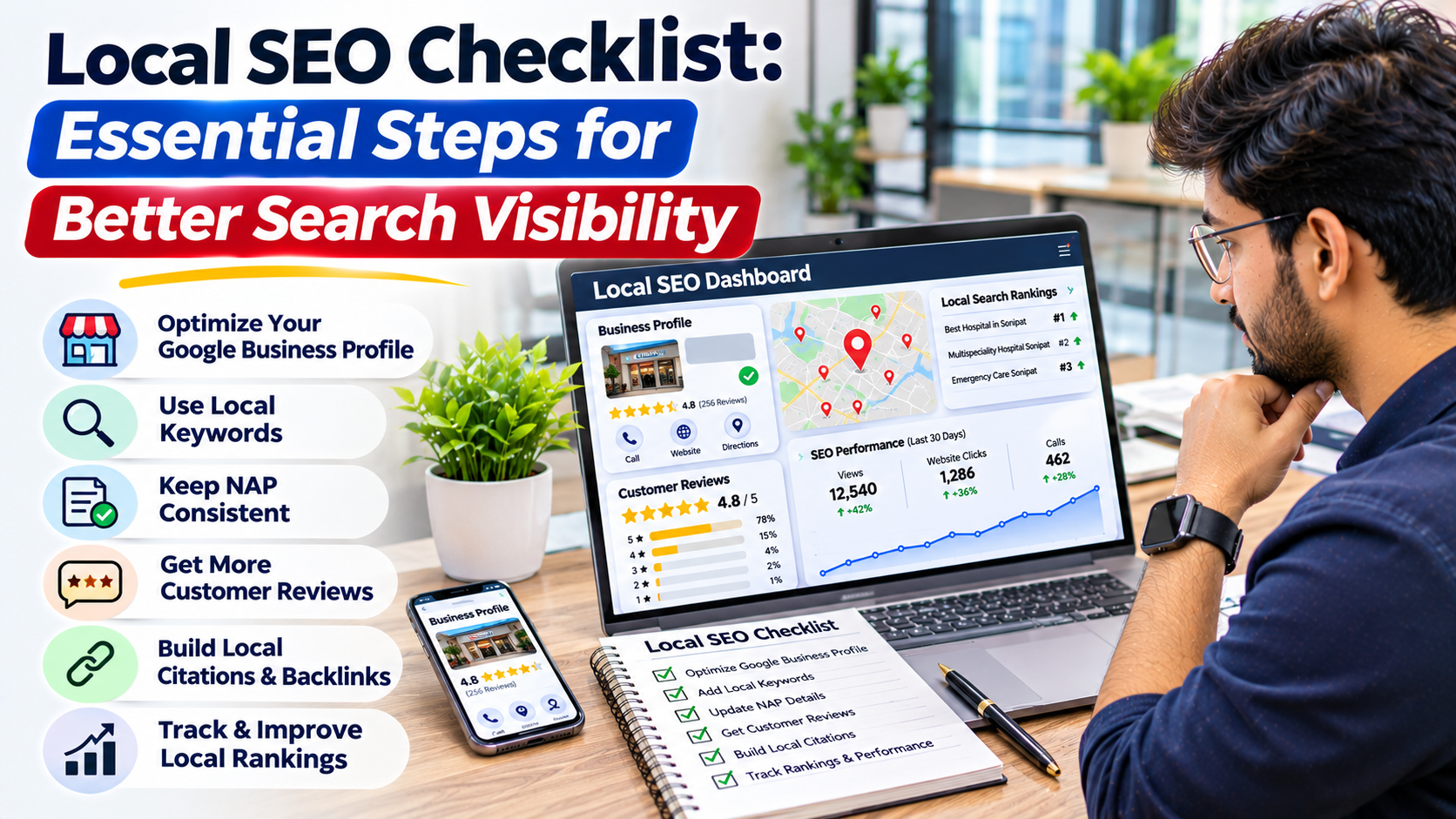
When people search for products or services near them, they usually want quick and relevant results. Whether someone is looking for a hospital, restaurant, digital marketing agency, repair service, or retail shop, Google helps them discover nearby businesses through local search results and Google Maps.
For local businesses, appearing in these searches can create valuable opportunities to attract potential customers, receive enquiries, and increase visits to their physical locations.
However, simply creating a website or registering a business on Google does not guarantee strong local search visibility. Businesses need to maintain accurate information, optimise their online presence, build local relevance, and regularly monitor their performance.
This is where a local SEO checklist becomes useful.
A structured checklist helps business owners understand which activities need attention and makes it easier to manage important local SEO tasks consistently.
Whether your business operates in Sonipat, Model Town, Sector 14, Murthal, Ganaur, Gohana, Kharkhoda, Kundli, or another nearby location, following the right local SEO practices can help improve your visibility in relevant searches.
In this guide, we will cover the essential steps businesses should follow to strengthen their local search presence.
1. Understand How Local SEO Works
Before starting optimisation, it is important to understand what local SEO actually means.
Local SEO is the process of improving a business’s online visibility for searches related to a specific geographical area.
For example, when someone searches for:
- Best digital marketing agency in Sonipat.
- Dentist near Model Town Sonipat.
- Restaurant near Geeta Bhawan Chowk.
- Website designer in Sector 14 Sonipat.
- AC repair service near Murthal Road.
- Hospital in Kharkhoda.
Google tries to show relevant businesses based on the search query, location, and other ranking signals.
Local search visibility generally includes three important areas:
Google Maps Results: Businesses appearing on Google Maps and local map listings.
Local Organic Results: Website pages ranking for location-based searches.
Business Information: Details such as business name, address, phone number, website, opening hours, and customer reviews.
A successful local SEO strategy should address all three areas rather than focusing only on Google Maps or website rankings.
2. Google Business Profile Optimization
Google Business Profile (GBP) is one of the most important elements of local SEO. It allows businesses to manage how their information appears across Google Search and Google Maps.
An incomplete or inaccurate profile may create confusion for potential customers and make it harder for Google to understand the business.
Use this checklist to review your profile.
Google Business Profile Checklist
- Claim your Google Business Profile.
- Complete the verification process.
- Use your real and accurate business name.
- Select the most relevant primary business category.
- Add appropriate secondary categories.
- Enter the correct business address.
- Add an accurate phone number.
- Add your official website URL.
- Set accurate business operating hours.
- Add special and holiday opening hours when applicable.
- Write a clear and informative business description.
- Add relevant products and services.
- Upload high-quality business photographs.
- Add your business logo and cover image.
- Include available appointment or booking links.
- Review your profile regularly for incorrect information.
Choose the Right Business Category
Your primary category should accurately describe your main business activity.
For example:
- A dental clinic should select a relevant dental category.
- A restaurant should choose an appropriate restaurant category.
- A digital marketing company should select a suitable marketing-related category.
- A hospital should choose an appropriate hospital category.
Avoid selecting unrelated categories simply because they contain popular keywords.
Write a Useful Business Description
Your business description should explain what your company does, which services it provides, and the areas it serves.
For example, a digital marketing agency serving Sonipat can naturally explain its SEO, website development, social media marketing, and online advertising services.
Avoid keyword stuffing or repeating the same location name unnecessarily.
3. Maintain Accurate Business Information Across the Internet
Business information accuracy is another essential part of local SEO.
Google and potential customers may encounter your business details on different platforms, including business directories, social media profiles, review websites, and your official website.
If these platforms show different phone numbers, addresses, or business names, customers may become confused.
This is why maintaining consistent business information is important.
Business Information Accuracy Checklist
- Keep the official business name consistent.
- Use the correct business address.
- Maintain the same primary contact number.
- Use the official website URL.
- Keep opening hours updated.
- Correct outdated business information.
- Update details after relocation.
- Remove duplicate or misleading business listings where possible.
- Check information across major online platforms.
- Ensure your website contact details match your Google Business Profile.
What Is NAP Consistency?
NAP stands for:
- Name
- Address
- Phone Number
NAP consistency means maintaining accurate and consistent business details across online platforms.
For example, if your business name is listed as “ABC Digital Solutions” on Google, avoid using completely different variations across directories without a genuine business reason.
Similarly, the phone number and address should match wherever the business is listed.
This helps customers identify the correct business and supports a reliable online presence.
4. Local Keyword Research
Keyword research helps you understand what potential customers search for when looking for products or services in your service area.
Instead of targeting only broad keywords, local businesses should identify relevant search terms that include service names, locations, and customer requirements.
For example, a digital marketing agency in Sonipat may target:
- Digital marketing agency in Sonipat.
- SEO services in Sonipat.
- Local SEO company in Sonipat.
- Website designing company in Sonipat.
- Google Business Profile optimization services.
- SEO agency near Model Town Sonipat.
Local Keyword Research Checklist
- Identify your primary service keywords.
- Find relevant location-based keywords.
- Research long-tail search queries.
- Identify keywords with commercial intent.
- Analyse competitor keywords.
- Check search volume and keyword difficulty.
- Identify service-related questions.
- Find keywords related to nearby areas.
- Separate informational and transactional keywords.
- Map keywords to relevant website pages.
Target Relevant Local Areas
Businesses serving Sonipat can research search terms related to areas such as:
Model Town Sonipat, Sector 7, Sector 8, Sector 12, Sector 14, Sector 15, Sector 23, Sector 27, Atlas Road, Subhash Chowk, Geeta Bhawan Chowk, Old Chowk, Railway Road, Kakroi Road, Gohana Road, and Murthal Road.
Businesses serving nearby locations may also consider relevant searches from Murthal, Ganaur, Gohana, Kharkhoda, Rai, Kundli, and other surrounding areas.
However, do not create unnecessary pages for every locality. Each location page should provide genuinely useful information and reflect the areas the business actually serves.
5. Optimise Your Website for Local Search
Your website plays an important role in helping search engines understand your services, business details, and geographical relevance.
Even if your Google Business Profile is well optimised, an incomplete website can limit the information available to potential customers.
Your website should clearly communicate:
- What your business offers.
- Where your business operates.
- Who your services are intended for.
- How customers can contact you.
- Why customers should consider your business.
On-Page Local SEO Checklist
- Add your primary local keyword to the relevant page title.
- Write unique meta titles for important pages.
- Create informative meta descriptions.
- Use descriptive and readable URL slugs.
- Include the main keyword naturally in the H1 heading.
- Organise content using relevant H2 and H3 headings.
- Add location references where they make sense.
- Include business contact information.
- Add internal links between relevant pages.
- Optimise images with descriptive file names.
- Write useful image alt text.
- Add clear calls to action.
- Ensure website content answers customer questions.
- Avoid duplicate or thin location pages.
Create Dedicated Service Pages
If your business offers multiple services, consider creating separate pages for important services.
For example, a digital marketing agency may create pages for:
- Search Engine Optimization.
- Local SEO Services.
- Social Media Marketing.
- Website Designing.
- Google Business Profile Optimization.
- PPC Advertising.
Each page should explain the service, its benefits, the business’s approach, and how customers can enquire.
This helps visitors find relevant information without searching through a single general services page.
6. Improve Google Maps Visibility
Google Maps is an important discovery platform for people searching for nearby businesses.
When someone searches for a service in a particular area, Google may display a map with relevant business profiles.
However, appearing on Google Maps is not guaranteed simply because a business has created a profile.
Google explains local results mainly through relevance, distance, and prominence.
Relevance: How closely a business profile matches what someone is searching for.
Distance: How far the business is from the searcher’s location or the location mentioned in the search.
Prominence: How well-known or established the business appears to be, based on information Google can evaluate.
Google Maps Visibility Checklist
- Complete your business profile.
- Select accurate business categories.
- Maintain correct location information.
- Add genuine business photographs.
- Keep operating hours updated.
- Encourage genuine customer reviews.
- Respond to customer reviews.
- Add relevant services.
- Maintain accurate website and contact details.
- Monitor customer questions and profile updates.
Check Rankings From Different Locations
A business may appear prominently on Google Maps for a search performed near its physical address but show different positions in another neighbourhood.
For example, a business located in Model Town Sonipat may have different visibility when someone searches from Sector 14, Murthal Road, or Gohana Road.
Therefore, local SEO reporting should consider multiple relevant search locations instead of relying on a single search from the business owner’s phone.
Remember that Google Maps rankings can change depending on the searcher’s location, query, and other factors.
7. Build Quality Local Citations and Business Listings
Local citations are online mentions of a business’s details, such as its name, address, phone number, and website.
These mentions may appear on business directories, local websites, industry platforms, and other relevant online resources.
Building accurate local citations can help customers discover your business and strengthen its overall online presence.
Local Citation Checklist
- Identify relevant business directories.
- Submit accurate business information.
- Use consistent NAP details.
- Add the official website URL.
- Select relevant business categories.
- Complete available profile information.
- Upload a business logo where appropriate.
- Check whether the listing is published.
- Monitor incorrect or duplicate listings.
- Update outdated contact information.
Focus on Relevant Business Listings
Not every directory is worth using.
Instead of submitting your business to hundreds of unrelated websites, prioritise platforms that are relevant to your industry, location, and audience.
For example, a healthcare business should focus on suitable healthcare-related directories and trustworthy local platforms.
A digital marketing agency may consider relevant business directories, professional listings, and industry-specific platforms.
Quality, relevance, and accuracy are more important than simply increasing the number of citations.
8. Create Location-Based Content
Location-based content helps businesses address the needs of customers searching for services in particular areas.
For example, a business operating in Sonipat can create useful content related to local customer requirements, service availability, and common questions.
However, creating dozens of pages by changing only the locality name is not a good local SEO practice.
Each location-based page should provide unique value.
Local Content Checklist
- Identify the main geographical areas you serve.
- Research location-specific customer searches.
- Create useful service-related blog topics.
- Publish informative local guides.
- Include relevant local keywords naturally.
- Add original and helpful information.
- Link articles to relevant service pages.
- Include suitable calls to action.
- Update outdated content.
- Avoid publishing duplicate location pages.
Examples of Local SEO Content Topics
A digital marketing agency targeting Sonipat businesses could publish articles such as:
- How Local SEO Helps Small Businesses in Sonipat.
- Why Google Business Profile Optimization Matters for Local Shops.
- How Businesses in Kundli Can Improve Their Google Maps Visibility.
- Local SEO Strategies for Businesses in Ganaur.
- How to Improve Website Visibility for Customers in Kharkhoda.
- Common Google Business Profile Mistakes Made by Local Businesses.
- How Customer Reviews Influence Local Business Visibility.
These topics can help attract relevant visitors while providing useful information to business owners.
9. Manage Customer Reviews and Online Reputation
Customer reviews influence how potential customers perceive a business.
Before contacting a company, many people check its ratings, read customer experiences, and compare different service providers.
Reviews can also contribute to Google’s understanding of a business’s prominence and relevance.
Review Management Checklist
- Encourage genuine customers to leave reviews.
- Share your official review link.
- Respond professionally to positive reviews.
- Address negative feedback politely.
- Avoid purchasing fake reviews.
- Do not offer incentives in exchange for positive reviews.
- Monitor new reviews regularly.
- Report reviews that genuinely violate platform policies.
- Use customer feedback to improve business services.
Why Responding to Reviews Matters
Responding to reviews shows that your business pays attention to customer feedback.
For positive reviews, thank customers for sharing their experiences.
For negative reviews, acknowledge the concern and offer an appropriate way to resolve the issue.
Avoid arguing with customers or sharing their private information in public responses.
A professional approach can help maintain trust and improve your business’s online reputation.
10. Implement Local Business Schema Markup
Schema markup is structured data that helps search engines understand information about a website.
For local businesses, relevant structured data can communicate details such as:
- Business name.
- Address.
- Phone number.
- Website URL.
- Business category.
- Opening hours.
- Geographic location.
LocalBusiness schema may be appropriate for many businesses, while more specific business types can be used when applicable.
Local Schema Checklist
- Identify the correct business type.
- Add the appropriate LocalBusiness structured data.
- Include accurate business name and contact details.
- Add the official website URL.
- Include the correct address where applicable.
- Add opening hours if available.
- Validate the structured data.
- Fix errors and warnings where necessary.
- Ensure schema information matches visible website content.
Structured data can help search engines interpret business information, but it does not guarantee higher rankings or special search result features.
11. Optimise Your Website for Mobile Users
Many local searches happen on mobile devices. Customers often use smartphones to find nearby services, check business details, call companies, or request directions.
If your website is difficult to use on a mobile screen, visitors may leave without contacting your business.
Mobile SEO Checklist
- Use a responsive website design.
- Ensure text is readable on smaller screens.
- Make navigation simple.
- Use clearly visible contact buttons.
- Make phone numbers clickable.
- Optimise images for faster loading.
- Avoid intrusive pop-ups.
- Test important forms on mobile devices.
- Check website performance.
- Ensure important information is easy to find.
A mobile-friendly website improves the experience for visitors and makes it easier for potential customers to take action.
12. Improve Website Speed and Technical SEO
Technical SEO helps search engines access, crawl, and understand your website.
A website may contain useful content and relevant local keywords but still face visibility problems if important technical issues are not addressed.
Technical SEO Checklist
- Ensure your website uses HTTPS.
- Check that important pages are indexable.
- Submit an XML sitemap to Google Search Console.
- Check the robots.txt file.
- Fix broken internal links.
- Identify and resolve important 404 errors.
- Use canonical tags correctly.
- Check mobile usability.
- Improve page loading performance.
- Review Core Web Vitals.
- Avoid duplicate content.
- Ensure important pages have internal links.
- Monitor indexing issues in Google Search Console.
Tools such as Google Search Console, PageSpeed Insights, and Google Analytics can help identify website issues and monitor performance.
13. Build Relevant Local Backlinks
Backlinks are links from other websites that point to your website.
Relevant and trustworthy backlinks can support your website’s authority and help search engines discover your content.
For local SEO, businesses can focus on earning links from websites that are genuinely relevant to their industry or geographical area.
Local Link Building Checklist
- Identify relevant local websites.
- Research industry-related websites.
- Look for genuine local partnership opportunities.
- Contribute useful expert articles where appropriate.
- Participate in relevant community initiatives.
- Create content that other websites may find valuable.
- Check the quality and relevance of linking domains.
- Monitor your backlink profile.
- Review potentially harmful or unnatural links.
Avoid buying large numbers of low-quality backlinks or participating in link schemes.
A smaller number of relevant, trustworthy links can be more valuable than a large collection of unrelated links.
14. Track Local SEO Performance Regularly
Local SEO is an ongoing process. Publishing content, updating a business profile, and building citations are not enough if you never measure the results.
Regular monitoring helps you understand which activities are working and where improvements are needed.
Local SEO Tracking Checklist
- Monitor local organic keyword rankings.
- Check Google Maps visibility for relevant searches.
- Review Google Business Profile performance.
- Monitor website organic traffic.
- Track phone calls and enquiries.
- Measure website form submissions.
- Monitor direction requests where available.
- Review customer ratings and feedback.
- Track new and lost backlinks.
- Monitor website indexing.
- Compare monthly SEO performance.
Useful Local SEO Tools
Google Business Profile: Manage business information and review available profile performance data.
Google Search Console: Monitor search queries, impressions, clicks, indexing, and website search performance.
Google Analytics 4: Understand website traffic, visitor behaviour, and conversions.
Google Keyword Planner: Research keyword ideas and estimated search demand.
Google PageSpeed Insights: Check website performance and identify speed-related improvements.
Google Trends: Explore changes in search interest over time.
Using these tools together can help businesses make informed SEO decisions.
15. Common Local SEO Mistakes to Avoid
Even after completing the basic optimisation tasks, businesses can make mistakes that affect their local search presence.
Here are some common problems to avoid:
1. Keyword Stuffing: Repeating the same location keyword unnaturally in website content or business descriptions.
2. Incorrect Business Information: Using outdated phone numbers, addresses, or opening hours.
3. Duplicate Google Business Profiles: Creating multiple profiles for the same eligible business location without a valid reason.
4. Fake Customer Reviews: Purchasing reviews or asking people to post experiences they never had.
5. Irrelevant Citations: Submitting business information to unrelated or poor-quality directories.
6. Duplicate Location Pages: Creating multiple pages with nearly identical content and only changing the locality name.
7. Ignoring Mobile Users: Having a website that is difficult to navigate on smartphones.
8. Neglecting Website Maintenance: Allowing broken links, outdated information, and technical errors to remain unresolved.
9. Expecting Instant Rankings: Assuming that local SEO improvements will produce immediate results.
10. Ignoring Performance Data: Continuing the same activities without reviewing rankings, enquiries, and customer behaviour.
Avoiding these mistakes can make your local SEO strategy more consistent and sustainable.
16. Local SEO Checklist for Businesses in Sonipat and Nearby Areas
Businesses operating in Sonipat and surrounding locations can use the following checklist to organise their local SEO activities.
Whether your business is located in Model Town, Sector 7, Sector 12, Sector 14, Sector 15, Sector 23, Sector 27, Atlas Road, Subhash Chowk, Railway Road, Kakroi Road, or Gohana Road, start by establishing a strong and accurate online presence.
Businesses serving Murthal, Ganaur, Gohana, Kharkhoda, Kundli, Rai, and nearby industrial areas should also identify the locations that are genuinely part of their service area.
For businesses targeting customers across Delhi NCR, location-based keyword research should reflect actual customer demand and service availability.
Complete Local SEO Action Checklist
| SEO Activity | Task | Status |
|---|---|---|
| Google Business Profile | Claim and verify business profile | ☐ |
| Google Business Profile | Select correct primary category | ☐ |
| Google Business Profile | Add accurate business information | ☐ |
| Google Business Profile | Upload quality photographs | ☐ |
| Google Business Profile | Add relevant services | ☐ |
| NAP Consistency | Check business name, address, and phone number | ☐ |
| Keyword Research | Identify primary local keywords | ☐ |
| Keyword Research | Find relevant long-tail keywords | ☐ |
| On-Page SEO | Optimise title tags and meta descriptions | ☐ |
| On-Page SEO | Add relevant location references | ☐ |
| Website SEO | Create useful service pages | ☐ |
| Website SEO | Improve internal linking | ☐ |
| Local Citations | Submit accurate business listings | ☐ |
| Reviews | Encourage genuine customer feedback | ☐ |
| Reviews | Respond to customer reviews | ☐ |
| Local Content | Publish useful location-based articles | ☐ |
| Technical SEO | Check indexing and sitemap | ☐ |
| Technical SEO | Improve website speed and mobile usability | ☐ |
| Schema Markup | Implement relevant local business schema | ☐ |
| Link Building | Earn relevant local backlinks | ☐ |
| Performance | Monitor rankings and organic traffic | ☐ |
| Performance | Track calls, enquiries, and conversions | ☐ |
You can use this checklist as a starting point for monthly local SEO audits and ongoing website optimisation.
17. How Digigyapan Can Help Improve Your Local SEO
Managing local SEO requires attention to several areas, including Google Business Profile optimisation, keyword research, website improvements, local citations, content creation, and performance tracking.
For business owners who do not have the time or technical knowledge to manage these activities, working with a digital marketing agency can help organise the process.
Digigyapan provides digital marketing services designed to help businesses strengthen their online presence.
Its services include:
- Search Engine Optimization (SEO).
- Local SEO.
- Google Business Profile Optimization.
- Keyword Research.
- Competitor Analysis.
- On-Page SEO.
- Off-Page SEO.
- Website Designing.
- Social Media Marketing.
- LinkedIn Optimization.
- Google-related digital marketing services.
Businesses in Sonipat, Model Town, Sector 14, Murthal, Ganaur, Gohana, Kharkhoda, Kundli, and nearby locations can explore suitable digital marketing strategies based on their business goals and target audience.
Whether you operate a local shop, healthcare centre, professional service company, educational institution, or industrial business, a properly planned local SEO strategy can help improve how potential customers discover your services online.
To learn more about Digigyapan’s digital marketing services, visit the official website: https://digigyapan.in/
Frequently Asked Questions About Local SEO
1. What is a local SEO checklist?
A local SEO checklist is a structured list of tasks that helps businesses improve their visibility in location-based search results. It typically includes Google Business Profile optimisation, keyword research, NAP consistency, local citations, website optimisation, reviews, and performance tracking.
2. Why is Google Business Profile important for local SEO?
Google Business Profile helps businesses manage their information across Google Search and Google Maps. An accurate and complete profile makes it easier for potential customers to discover important details such as business hours, address, services, and contact information.
3. How can I improve my Google Maps visibility?
Start by maintaining an accurate and complete Google Business Profile. Select relevant categories, update business information, add genuine photographs, encourage authentic customer reviews, and make sure your website supports your business information.
However, Google Maps rankings also depend on factors such as relevance, distance, and prominence.
4. What is NAP consistency in local SEO?
NAP stands for Name, Address, and Phone Number. NAP consistency means maintaining accurate business information across your website, Google Business Profile, directories, and other online platforms.
5. Are local citations still important?
Accurate local citations can help people discover your business and support a consistent online presence. Focus on relevant and trustworthy platforms rather than submitting your information to every available directory.
6. How many keywords should a local business target?
There is no fixed number. Businesses should focus on relevant keywords that match their services, customer requirements, and actual service locations. A smaller group of well-researched keywords is often more useful than a large list of unrelated search terms.
7. How long does local SEO take to show results?
Local SEO does not have a fixed result timeline. Improvements depend on competition, website quality, business information, location, existing online presence, and the work being completed. Regular optimisation and performance monitoring are important.
8. Can a business rank in multiple locations?
A business may appear in searches across multiple locations, depending on its relevance, distance, prominence, and service availability. However, visibility can vary from one area to another. Businesses should create useful location-specific content only where it provides genuine value.
9. Which tools are useful for local SEO?
Useful tools include Google Business Profile, Google Search Console, Google Analytics 4, Google Keyword Planner, Google Trends, and PageSpeed Insights. These tools help with profile management, keyword research, traffic analysis, and technical website monitoring.
10. Is local SEO useful for small businesses?
Yes. Local SEO can help small businesses reach people searching for relevant products and services in their area. It can improve online discovery, support customer enquiries, and help businesses compete more effectively in local markets.
Conclusion
Improving local search visibility requires more than creating a Google Business Profile or adding a few location-based keywords to your website. Businesses need to maintain accurate information, understand customer search behaviour, optimise their websites, manage customer reviews, build relevant citations, and monitor their performance.
A well-organised local SEO checklist makes these activities easier to manage and helps identify areas that need improvement.
For businesses operating in Sonipat, Model Town, Sector 7, Sector 14, Murthal, Ganaur, Gohana, Kharkhoda, Kundli, and surrounding areas, consistent local SEO practices can support better online visibility and help potential customers discover relevant services.
Start with the essential tasks, review your progress regularly, and focus on providing accurate and useful information to customers.
With a consistent strategy and the right optimisation approach, your business can build a stronger local online presence and create more opportunities to connect with potential customers.