
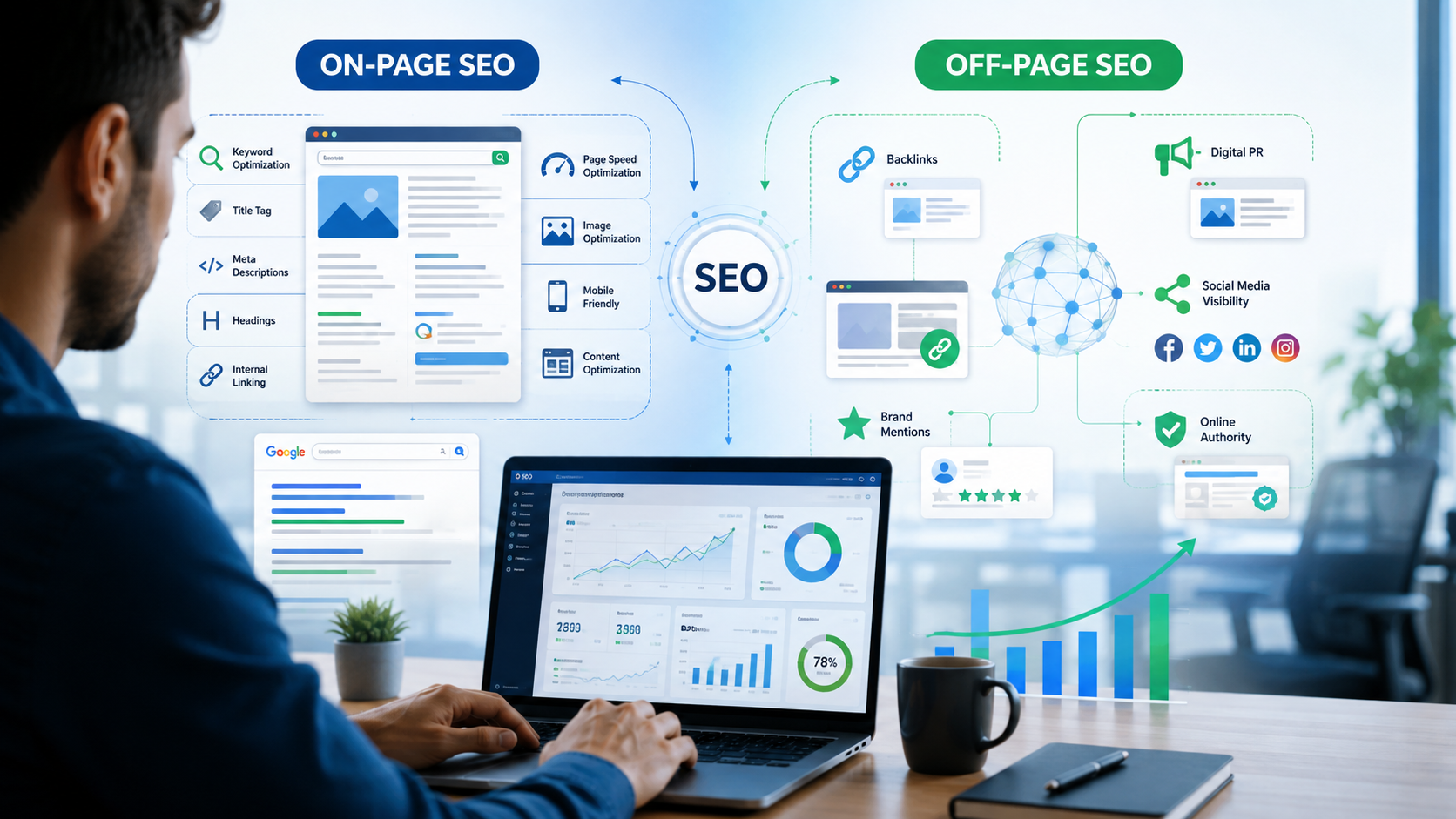
Search engine optimization (SEO) is one of the most important strategies for improving a website’s visibility on search engines like Google. But SEO is not just about adding keywords to your website. Two major parts of SEO—On-Page SEO and Off-Page SEO—work together to improve rankings, authority, traffic, and overall online visibility.
If you are new to SEO, understanding the difference between these two approaches can help you build a stronger and more effective SEO strategy.
What Is On-Page SEO?
On-Page SEO refers to the optimization techniques you apply directly to your website and its individual pages. The goal is to help search engines understand your content while also making the page useful and easy to navigate for visitors.
Important On-Page SEO Factors
1. Keyword Optimization
Using relevant keywords naturally throughout your content helps search engines understand what your page is about. Keywords can be included in the title, headings, introduction, body content, URL, and image alt text.
However, keyword stuffing should be avoided. Content should always sound natural and provide genuine value.
2. Title Tags
The title tag tells search engines and users what a webpage is about. A clear, relevant, and compelling title can improve both search visibility and click-through rates.
3. Meta Descriptions
A meta description provides a short summary of a webpage in search results. Although it is not a direct ranking factor, a well-written description can encourage users to click on your result.
4. Headings and Content Structure
Using H1, H2, and H3 headings makes content easier to read and helps search engines understand the structure of your page.
5. URL Optimization
Short, descriptive URLs are easier for both users and search engines to understand. For example:
website.com/on-page-vs-off-page-seo
is generally clearer than:
website.com/page?id=12345
6. Internal Linking
Internal links connect one page of your website to another. They help visitors discover related content and help search engines understand the relationship between different pages.
7. Image Optimization
Images should have descriptive file names and appropriate alt text. Compressing images can also help improve page loading speed.
8. User Experience and Page Speed
A website that loads quickly, works well on mobile devices, and provides an easy browsing experience is more likely to satisfy visitors. Technical performance is therefore an important part of modern SEO.
What Is Off-Page SEO?
Off-Page SEO includes activities performed outside your own website to improve its authority, reputation, and visibility.
While On-Page SEO focuses on optimizing your website, Off-Page SEO focuses largely on how other websites and online platforms perceive and reference your website.
Important Off-Page SEO Factors
1. Backlinks
Backlinks are links from other websites pointing to your website. High-quality backlinks from relevant and trustworthy websites can strengthen your website’s authority.
For example, a relevant industry website mentioning your business and linking to your website can provide a valuable SEO signal.
2. Digital PR
Getting your business, website, or expertise mentioned in reputable online publications can increase brand visibility and potentially generate valuable backlinks.
3. Brand Mentions
Even when another website does not link directly to your website, mentions of your brand can contribute to broader online visibility and reputation.
4. Social Media Visibility
Social media activity is not simply a direct ranking shortcut, but it can help distribute your content, increase brand awareness, and attract visitors who may eventually link to or reference your content.
5. Local SEO Signals
For local businesses, maintaining accurate business information across relevant platforms and earning positive reviews can support local visibility and credibility.
On-Page SEO vs Off-Page SEO: Key Differences
| On-Page SEO | Off-Page SEO |
|---|---|
| Done directly on your website | Done outside your website |
| Focuses on content and page optimization | Focuses on authority and reputation |
| Includes keywords, headings, URLs, and internal links | Includes backlinks, PR, mentions, and outreach |
| Gives you greater direct control | Depends partly on external websites and platforms |
| Improves relevance and user experience | Helps build credibility and authority |
Which One Is More Important?
The answer is both.
A website with excellent content but no authority may struggle to compete for highly competitive keywords. On the other hand, a website with many backlinks but poor content and user experience may also struggle to perform well.
Think of it this way:
On-Page SEO tells Google what your website is about.
Off-Page SEO helps demonstrate that your website is trustworthy and authoritative.
A successful SEO strategy combines both.
How On-Page and Off-Page SEO Work Together
Imagine you own a healthcare website and publish an informative article about common symptoms of a particular condition.
Your On-Page SEO could include:
- A relevant primary keyword
- A clear SEO title
- Helpful headings
- Well-written and original content
- Internal links to related healthcare pages
- Optimized images
- A mobile-friendly page
- Fast loading speed
Your Off-Page SEO could include:
- Earning backlinks from reputable healthcare websites
- Getting the article referenced by relevant publications
- Promoting the content through social media
- Building the credibility of your brand online
Together, these activities can improve the page’s ability to attract relevant organic traffic.
Common SEO Mistakes to Avoid
Whether you are working on On-Page or Off-Page SEO, avoid these common mistakes:
Keyword Stuffing
Repeating the same keyword excessively can make content unnatural and negatively affect the user experience.
Buying Low-Quality Backlinks
A large number of irrelevant or low-quality backlinks does not automatically improve rankings. Focus on earning relevant, trustworthy links.
Publishing Thin Content
Creating pages simply to target keywords without providing useful information can result in poor user experiences.
Ignoring Technical SEO
Slow loading speeds, broken links, poor mobile usability, and indexing problems can limit the performance of otherwise good content.
Focusing Only on Rankings
SEO success is not just about ranking for keywords. Traffic quality, engagement, conversions, leads, and business results matter too.
A Simple SEO Strategy for Businesses
If you are starting SEO for your business, begin with a strong foundation:
Step 1: Research relevant keywords and understand search intent.
Step 2: Optimize important website pages for those keywords.
Step 3: Publish useful, original, and relevant content regularly.
Step 4: Improve website speed, mobile usability, navigation, and technical SEO.
Step 5: Build high-quality backlinks through valuable content, digital PR, partnerships, and genuine outreach.
Step 6: Monitor organic traffic, rankings, conversions, and other SEO performance indicators.
Final Thoughts
On-Page SEO and Off-Page SEO are two essential parts of a complete SEO strategy. On-Page SEO focuses on making your website relevant, useful, structured, and technically sound, while Off-Page SEO focuses on building authority, credibility, and online recognition.
Instead of choosing one over the other, businesses should work on both consistently. Strong content combined with a trustworthy online presence can create a solid foundation for long-term organic growth.