
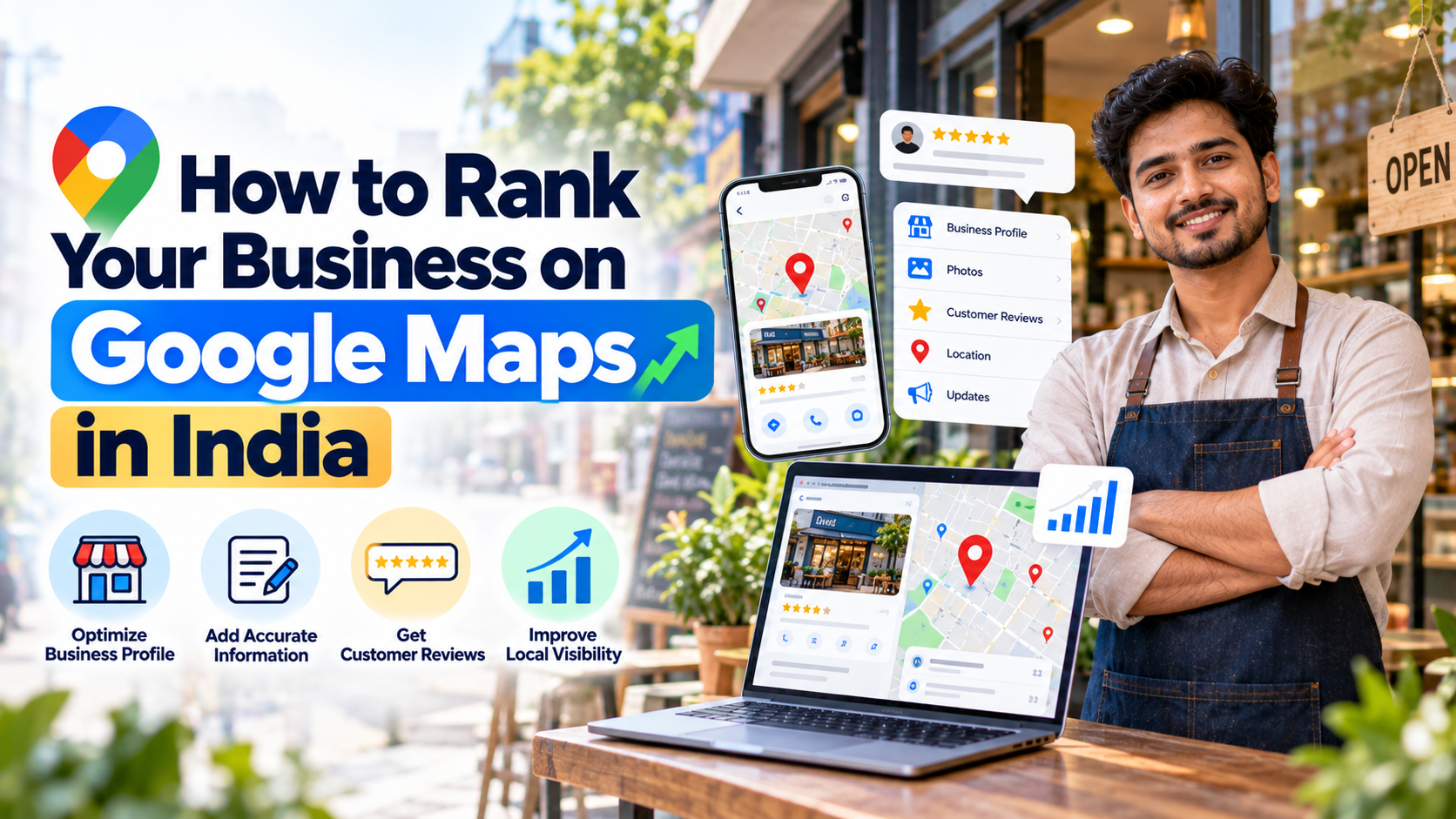
If you want to attract more local customers, learning how to rank your business on Google Maps is an essential part of your digital marketing strategy. Whether you run a retail shop, dental clinic, restaurant, consultancy, salon, or service-based business in India, appearing prominently in local search results can help potential customers discover your business when they need your products or services.
Google Maps connects people with nearby businesses by displaying relevant business information, directions, customer reviews, contact details, and websites. A well-optimized Google Business Profile can help your business improve local visibility and generate more calls, visits, and enquiries.
However, ranking on Google Maps is not simply about creating a business listing. It requires accurate business information, relevant categories, genuine customer reviews, a useful website, and consistent local SEO efforts.
In this guide, you will learn how to rank your business on Google Maps in India, optimize your Google Business Profile, strengthen your local online presence, and turn local searches into potential customers.
What Is Google Maps SEO?
Google Maps SEO is the process of optimizing your business’s online presence to improve its visibility in Google Maps and local search results.
For example, when someone searches for “digital marketing agency in Ahmedabad” or “dentist near me,” Google may display a map with nearby businesses. This section of the results is commonly called the local pack or Google Maps 3-pack.
Businesses with relevant information, accurate profiles, strong reputations, and an established online presence may have a better chance of appearing prominently for appropriate searches.
For Indian small and medium businesses, local SEO can be particularly useful because it helps connect a business with people searching for nearby services.
How Does Google Rank Businesses on Google Maps?
Before you try to rank your business on Google Maps, you need to understand the three main factors Google identifies for local rankings: relevance, distance, and prominence.
1. Relevance
Relevance refers to how well your business profile matches what a customer searches for.
For example, a person searching for “AC repair service” wants a business that actually provides air-conditioning repairs. An accurate primary category, detailed service information, and a clear business description help Google understand what your business offers.
2. Distance
Distance refers to how far your business is from the person searching or the location specified in the search.
A business may appear for a search in one neighbourhood but not another. You cannot manipulate this factor by changing your business address to a location where you do not operate.
3. Prominence
Prominence refers to how well-known your business is online and in the real world. Google considers information such as reviews, ratings, links, and other signals of reputation.
You can work on relevance and prominence through legitimate optimization, although no business can control every ranking factor.
Google does not offer a way to request or pay for better organic local rankings.
How to Rank Your Business on Google Maps in India: 10 Practical Steps
1. Create and Verify Your Google Business Profile
The first step is to create or claim your Google Business Profile. Google Business Profile is the platform that allows eligible businesses to manage how their information appears on Google Search and Maps.
Visit Google Business Profile and sign in with the Google account you want to use to manage your business.
Follow these steps:
- Search for your business to check whether a listing already exists.
- Claim the existing profile or create one if necessary.
- Enter your real business name.
- Add your business address if customers visit your location.
- Specify your service area if you travel to customers.
- Add your contact details, website, and business hours.
- Complete the verification process offered by Google.
Verification helps establish that you are authorized to manage the profile. The available verification method may vary by business.
Do not create duplicate profiles for the same business or use a virtual office or false address to target another area.
2. Choose the Right Primary and Secondary Categories
Your business category helps Google understand the services you provide and the searches for which your profile may be relevant.
Choose the most specific primary category that accurately describes your main business activity.
For example:
- A dental practice should select an appropriate dental category.
- A restaurant should select the category that best represents its cuisine or business type.
- A digital marketing agency should choose a suitable marketing-related category.
- An automobile repair shop should select an appropriate vehicle repair category.
Add secondary categories only when they accurately represent additional business activities.
Avoid choosing unrelated categories simply because you want to appear for more keywords. Relevant categories are more useful than an unnecessarily long list.
3. Complete Every Relevant Business Profile Section
A complete Google Business Profile gives potential customers useful information and helps Google understand your business.
Review the following details:
- Business name
- Primary and secondary categories
- Address or service area
- Phone number
- Website URL
- Opening hours and holiday hours
- Business description
- Available services or products
- Relevant business attributes
- Real business photographs
Write a clear business description that explains what you do, whom you serve, and which services customers can expect.
For example, a digital marketing agency in Ahmedabad could describe its SEO, website development, and online marketing services, provided these are genuinely offered.
Keep the information accurate and customer-focused. Do not add promotional offers, phone numbers, or extra keywords to your business name unless they are genuinely part of your real-world business name.
4. Optimize Your Google Business Profile With Local Keywords
Local keywords help you understand how potential customers search for businesses like yours.
Useful search phrases may include:
- Digital marketing agency in Ahmedabad
- Best dentist in Surat
- Website development company in Mumbai
- AC repair service in Pune
- Interior designer in Jaipur
- SEO services for small businesses in India
Choose keywords based on your actual services, business location, and customer needs.
Incorporate relevant phrases naturally into your business description, service descriptions, website pages, and useful content. Use the most appropriate business categories rather than trying to insert every keyword into the profile.
Remember that adding a keyword repeatedly does not guarantee higher rankings. The objective is to communicate your services clearly and match the intent behind relevant local searches.
5. Collect Genuine Google Reviews and Respond to Them
Customer reviews can influence how potential customers perceive your business, and Google identifies reviews and ratings as signals associated with local prominence.
Develop a consistent process for requesting honest feedback from customers after a completed purchase or service.
You can:
- Share your official Google review link with customers.
- Send a polite follow-up message after a service.
- Add a review link to an appropriate customer communication.
- Respond professionally to positive and negative feedback.
- Use customer feedback to identify opportunities to improve your service.
For example, a business could send this message:
“Thank you for choosing our business. We would appreciate your honest feedback about your experience. You can share your review here: [Insert Google review link].”
Never purchase fake reviews, offer rewards in exchange for positive reviews, or ask customers to change an honest review in exchange for compensation. Follow Google’s review policies.
Respond to negative reviews calmly, acknowledge genuine concerns, and explain how the customer can contact you to resolve the issue.
6. Add High-Quality Photos and Videos
Photos help potential customers understand what your business looks like and what they can expect when they visit or contact you.
Upload genuine, clear images that accurately represent your business.
Depending on your business type, useful photos may include:
- Your storefront and entrance
- Interior and exterior views
- Products and completed projects
- Staff and team members
- Equipment and facilities
- Before-and-after project images, where appropriate
For a restaurant, photographs of the dining area and menu items may help customers make a decision. For a service business, genuine photographs of completed work can help establish credibility.
Keep your images current and avoid misleading stock photographs that customers could mistake for your actual premises or work.
7. Optimize Your Website for Local SEO
Your website can support your efforts to rank your business on Google Maps by providing consistent business information and relevant details about your services.
Start with these improvements:
Create dedicated service pages. Explain each major service on its own page when it provides enough unique value to users.
Add location-specific content. If your business genuinely serves Ahmedabad, for example, explain your services and relevant experience in that market.
Keep business details consistent. Ensure that your business name, address, and phone number match your verified business information wherever applicable.
Improve mobile usability. Make sure visitors can easily read your content, navigate your website, and contact you from a mobile phone.
Add clear contact information. Include your phone number, contact page, service details, and relevant location information.
Use structured data where appropriate. LocalBusiness structured data can help search engines interpret factual information about an eligible business. Ensure that the markup matches information visible on your website.
Avoid creating dozens of near-identical location pages with only the city name changed. Each location page should provide useful, accurate information about the services actually available in that area.
8. Build Consistent Local Citations and Relevant Links
Local citations are online mentions of your business, often including its name, address, phone number, website, and category.
Maintain accurate listings on relevant, trustworthy platforms, such as established Indian business directories and appropriate industry-specific websites.
Your priorities should be:
- Correcting outdated business information.
- Removing or resolving duplicate listings where possible.
- Keeping your website and major directory listings consistent.
- Listing your business on relevant industry platforms.
- Earning genuine links from relevant local organizations, partners, publications, or community websites.
Do not submit your business to hundreds of low-quality directories merely to increase listing volume. Prioritize relevance, accuracy, and trustworthiness.
9. Publish Useful Local Content and Keep Your Profile Updated
Regularly updating useful business information helps customers understand your current offerings.
Depending on your business, you may publish announcements, seasonal offers, new product information, service updates, or helpful answers to common customer questions.
You can also create website content addressing questions customers ask before making a purchase.
For example, a local service provider might publish a guide explaining service costs, the work involved, common maintenance problems, or how customers can choose a suitable provider.
Google Business Profile posts should be used when they provide genuine value to customers, not as a guaranteed ranking trick. Keep your hours, services, contact details, and other profile information accurate.
10. Track Google Maps Rankings and Customer Actions
Local SEO should be measured using business outcomes as well as rankings.
Monitor performance using the reporting tools available in your Google Business Profile and your website analytics setup.
Useful metrics include:
- Searches that display your business profile
- Profile views and interactions
- Website clicks
- Calls generated through your profile
- Direction requests
- Qualified website enquiries
- Leads and sales attributed to local search
Where possible, compare performance over consistent periods and track your main services separately.
Remember that Google Maps rankings vary by searcher’s location, search term, and other factors. Checking your own position once from your office does not provide a complete picture of your visibility.
How to Rank Your Business on Google Maps in a Competitive Indian Market
Local competition varies between cities, neighbourhoods, and industries. A business competing in a crowded metropolitan area may need a more comprehensive local SEO strategy than one serving a smaller market.
Use these practical approaches to strengthen your local presence.
Focus on the Most Valuable Local Searches
Identify the services most likely to generate profitable enquiries. Research the search phrases customers use and compare the businesses currently appearing for those queries.
Prioritize a small group of relevant service and location combinations rather than targeting every possible keyword.
Analyze Competing Business Profiles
Study competing businesses to understand how they present their services, which categories they use, what information is missing from your own profile, and how customers describe their experiences.
Look for legitimate opportunities to improve your own service descriptions, website content, customer experience, and review response process.
Do not copy competitors’ descriptions or misrepresent your business.
Strengthen Your Local Reputation
Develop relationships with relevant local organizations, professional associations, suppliers, and community groups where appropriate.
Earn genuine mentions and links through useful content, partnerships, and real business activity.
A strong reputation takes time to establish, but it can support both customer confidence and local visibility.
Common Mistakes That Can Hurt Your Google Maps Visibility
Avoid these common local SEO mistakes:
- Keyword stuffing the business name: Use your real-world business name, not a list of target keywords.
- Creating duplicate profiles: Duplicate listings can confuse customers and may violate Google’s policies.
- Using an inaccurate address: Never claim an office, shop, or service location where your business is not legitimately established.
- Buying fake reviews: Fake engagement can damage trust and create policy risks.
- Ignoring negative feedback: Respond constructively and address legitimate customer concerns.
- Leaving important information outdated: Incorrect phone numbers and opening hours can lose potential customers.
- Publishing thin location pages: Create content that genuinely helps customers in each area you serve.
- Expecting immediate results: Local SEO is an ongoing process, and the timing of ranking improvements cannot be guaranteed.
How Long Does It Take to Rank Your Business on Google Maps?
There is no universal timeline for ranking a business on Google Maps.
Some corrections, such as fixing an incorrect phone number or selecting an accurate category, may be reflected after Google processes the changes. Building a stronger reputation, earning relevant mentions, and improving competitiveness may take considerably longer.
Your progress depends on factors such as:
- Your industry’s competition
- Your current business profile quality
- Your location and proximity to searchers
- Your website’s relevance and quality
- Your existing reputation and reviews
- The specific searches you want to target
Set realistic goals and review performance regularly. Avoid agencies that promise a guaranteed first-place ranking or a fixed result regardless of your market and starting position.
Why Should Indian Businesses Invest in Local SEO?
Local SEO helps businesses become easier to discover when people search for relevant products and services.
A well-managed Google Business Profile can support customer discovery, website visits, calls, direction requests, and enquiries.
For small and medium businesses, local SEO can complement paid advertising, social media marketing, referral programmes, and other customer acquisition channels.
Its value should be assessed by the quality of enquiries and business results it generates—not just by whether a listing appears in a particular position.
Frequently Asked Questions About Ranking on Google Maps
How can I rank my business on Google Maps for free?
Claim and verify your Google Business Profile, select accurate categories, complete your business information, add genuine photos, request honest customer reviews, respond to feedback, and maintain a useful website. These steps can improve your local search presence without requiring payment for advertising.
How do I rank higher on Google Maps in India?
Start by optimizing your verified Google Business Profile, ensuring that your services and location are accurately represented. Build a genuine review process, improve your website’s local SEO, maintain consistent business information, and earn relevant local mentions. Results depend on competition, distance, relevance, and prominence.
Does Google Business Profile help with local SEO?
Yes. Google Business Profile is an important part of local SEO because it allows eligible businesses to manage their information on Google Search and Maps. A complete, accurate profile helps customers understand your services and supports Google’s understanding of your business.
How many Google reviews do I need to rank on Google Maps?
There is no publicly specified number of reviews that guarantees a particular position. Focus on collecting genuine reviews consistently, providing excellent customer service, and responding professionally. Review quality and ratings matter to customer trust, while local rankings depend on multiple factors.
Can I rank my business on Google Maps without a website?
Yes. An eligible, verified Google Business Profile can appear on Google Maps without a website. However, a useful website can provide additional information about your services, support customer enquiries, and strengthen your overall online presence.
Why is my business not appearing on Google Maps?
Possible reasons include an unverified or restricted profile, incomplete or inaccurate business information, an inappropriate category, limited relevance to the search, or strong local competition. Check your profile status and details first, then review your website, reputation, and local SEO strategy.
Can I rank my business on Google Maps in multiple cities?
You may serve customers across multiple cities, but you must represent your business accurately. Do not create fake offices or duplicate profiles to target additional locations. Businesses with genuine, eligible locations may manage separate profiles for those locations, subject to Google’s guidelines.
Does adding keywords to my Google Business Profile name improve rankings?
Adding keywords that are not part of your legitimate real-world business name can violate Google’s guidelines and create suspension risks. Use the correct business name and optimize the appropriate categories, service details, description, and website content instead.
Is Google Maps SEO better than Google Ads?
They serve different purposes. Local SEO focuses on organic visibility and reputation, while Google Ads provides paid advertising opportunities. The right approach depends on your budget, competition, customer acquisition goals, and timeline. Many businesses benefit from using both strategically.
Should I hire a local SEO agency to rank my business on Google Maps?
An experienced local SEO agency can help with profile optimization, website improvements, review management processes, local content, competitor analysis, and performance reporting. Before hiring an agency, ask about its methods, reporting process, experience, and approach to Google’s guidelines. Avoid guaranteed-ranking claims.
Conclusion: Start Improving Your Google Maps Visibility Today
Learning how to rank your business on Google Maps is an important step toward building a stronger local online presence in India.
Start with the essentials: verify your profile, choose the correct categories, complete your business information, collect genuine reviews, upload accurate photos, and optimize your website for relevant local searches.
Then build on that foundation with consistent business information, useful local content, a stronger online reputation, and regular performance measurement.
Local SEO is not a one-time task. It requires ongoing attention to your customers, your business information, and the competitive environment in which you operate.
If you want a structured strategy to improve your local search visibility and attract more relevant enquiries, consider working with an experienced SEO team that understands your business goals and target market.
Ready to improve your local visibility? Explore the SEO resources available on Digigyapan and get in touch to discuss an SEO strategy tailored to your business.
Suggested internal link: 7 Ways to Optimize Google Business Profile
Suggested conversion link: Digigyapan