
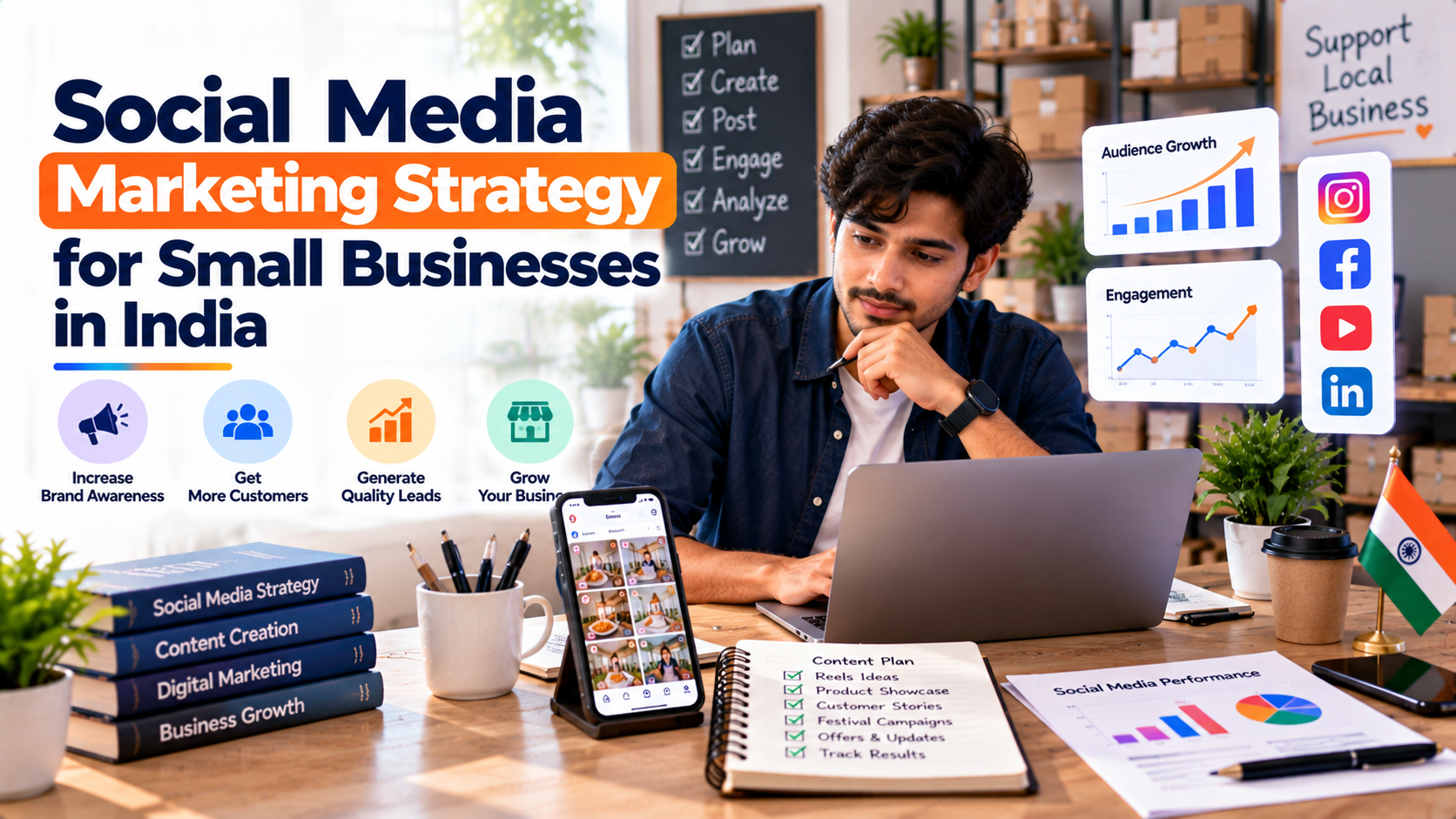
Running a small business in India requires more than offering quality products or services. You also need to reach the right customers, build trust, and stay visible in an increasingly digital marketplace. A well-planned social media marketing strategy helps small businesses connect with potential customers, increase brand awareness, generate enquiries, and support business growth without depending entirely on expensive advertising.
Whether you operate a retail shop in Model Town Sonipat, a service business in Sector 14 Sonipat, a manufacturing unit in Rai Industrial Area, or a startup serving customers across Delhi NCR, social media can become a valuable part of your marketing plan.
The key is to use the right platforms, publish relevant content, communicate consistently, and measure results.
In this guide, we explain how to create an effective social media marketing strategy for small businesses in India, with practical examples and local marketing ideas for businesses in Sonipat, Haryana, and surrounding areas.
What Is a Social Media Marketing Strategy?
A social media marketing strategy is a structured plan for using platforms such as Instagram, Facebook, LinkedIn, YouTube, and WhatsApp to achieve specific business goals.
These goals may include increasing brand awareness, attracting local customers, generating qualified leads, improving customer engagement, or increasing sales.
An effective strategy includes:
- Clearly defined marketing objectives.
- Research into your target audience.
- Selection of appropriate social media platforms.
- A consistent content calendar.
- Organic social media activities and paid advertising, where appropriate.
- A process for responding to enquiries and following up with prospects.
- Performance tracking and regular optimization.
Instead of posting randomly, a business with a clear strategy understands what to publish, whom to target, and how each activity contributes to growth.
Why Do Small Businesses in India Need a Social Media Marketing Strategy?
Social media offers small businesses an opportunity to compete for customer attention without requiring the same marketing resources as large companies.
1. Build Brand Awareness
Customers are more likely to consider businesses they recognize and trust. Regularly sharing useful information, product demonstrations, customer stories, and business updates helps your brand remain visible to potential buyers.
For example, a clothing store in Sector 7 Sonipat can showcase new arrivals, seasonal collections, and styling tips through Instagram Reels and Facebook posts.
2. Reach Local Customers
A local social media marketing strategy helps businesses communicate with people in their service areas.
A salon near Geeta Bhawan Chowk, a coaching institute on Atlas Road, or a home service provider in Kundli can publish location-relevant content and use appropriate geographic targeting in advertising campaigns.
Local relevance makes it easier to attract enquiries from customers who can realistically visit the business or use its services.
3. Generate Business Leads
Social media can support lead generation through direct messages, WhatsApp conversations, enquiry forms, appointment bookings, and website visits.
For example, a digital marketing agency can publish a post explaining common SEO mistakes and invite interested business owners to request a website audit.
The objective is not simply to collect likes. It is to encourage relevant people to take meaningful next steps.
4. Build Customer Trust
Customers often want to understand a business before contacting it. Helpful educational posts, genuine testimonials, behind-the-scenes content, and clear service information can make a business appear more approachable.
Always use authentic customer feedback and obtain permission before publishing identifiable customer information.
5. Market Your Business Within Your Budget
Many social platforms allow businesses to establish a presence and publish organic content without paying for every post.
Paid advertising requires a budget, but campaigns can often be tested with controlled spending before additional investment. Actual costs and results depend on the audience, competition, campaign objective, and quality of the offer.
How to Create a Social Media Marketing Strategy for Small Businesses in India
A successful strategy starts with business goals and customer needs, rather than the number of posts you plan to publish.
Step 1: Define Your Marketing Goals
Start by identifying the most important outcome you want social media to deliver.
Your goals might include:
- Increasing awareness of a new business.
- Generating enquiries for a service.
- Driving more visitors to a physical store.
- Selling products through a website or messaging channel.
- Building a community around your brand.
- Increasing repeat purchases from existing customers.
Choose one primary goal and two or three supporting metrics.
For example, a local service provider in Sonipat might focus on generating qualified WhatsApp enquiries, tracking the number of consultations booked, and measuring how many enquiries become paying customers.
Clear objectives help you avoid spending time on activities that do not support your business priorities.
Step 2: Understand Your Target Audience
Your social media marketing strategy should reflect the needs, preferences, and buying behaviour of your ideal customers.
Consider the following questions:
- Who is most likely to buy your product or service?
- What problems are they trying to solve?
- What questions do they ask before making a purchase?
- Which social media platforms do they use?
- What factors influence their buying decisions?
- Do they prefer Hindi, English, or a combination of both?
For businesses in Sonipat, language and location can make a practical difference. Depending on your audience, a combination of Hindi and English content may communicate more effectively than English-only posts.
A manufacturing company targeting business buyers may need detailed LinkedIn content, while a neighbourhood restaurant may get more value from attractive food videos, local promotions, and customer reviews.
Step 3: Choose the Right Social Media Platforms
You do not need to be active on every platform. Start with the channels that best match your audience and business model.
Instagram Marketing
Instagram can be useful for fashion stores, salons, restaurants, fitness studios, home decor businesses, beauty brands, and other visually oriented businesses.
Content ideas include product demonstrations, short videos, before-and-after examples where appropriate, tutorials, new arrivals, and customer FAQs.
Facebook Marketing
Facebook can support local business awareness, community engagement, event promotion, business updates, and advertising campaigns.
It can be particularly useful when your target customers participate in relevant local groups or respond to community-oriented content. Follow group rules and avoid unsolicited promotional posting.
WhatsApp Business
WhatsApp Business can help businesses manage customer conversations, share catalogues where applicable, respond to product questions, and follow up on enquiries.
Use clear business information and obtain appropriate consent before sending promotional messages. Avoid unsolicited bulk messaging.
LinkedIn Marketing
LinkedIn is relevant for B2B companies, consultants, manufacturers, recruitment services, professional firms, and agencies.
Businesses operating in Rai Industrial Area, Kundli Industrial Area, Barhi Industrial Area, or IMT Kharkhoda may use LinkedIn to share industry insights, capabilities, case studies, and professional updates with relevant business audiences.
YouTube Marketing
YouTube can help businesses build long-term visibility through tutorials, product demonstrations, explainers, customer education, and detailed service videos.
Choose one or two primary platforms initially. Expand only when you can maintain quality and respond to customers consistently.
Step 4: Build a Content Strategy
A strong social media content strategy balances educational, promotional, trust-building, and engagement-focused posts.
Use these five content categories as a starting point:
Educational content: Answer common customer questions, explain industry concepts, and share practical tips.
Product or service content: Demonstrate how your offering works and explain its benefits.
Trust-building content: Share authentic testimonials, team introductions, behind-the-scenes videos, and completed projects.
Engagement content: Publish polls, quizzes, relevant questions, and community-focused posts.
Promotional content: Announce offers, launches, events, or consultations with clear terms and calls to action.
For example, a digital marketing agency serving Sonipat businesses might publish a search engine optimization tip on Monday, a short video about social media mistakes on Wednesday, and a client-approved project explanation on Friday.
This approach gives followers value instead of presenting every post as a sales pitch.
Step 5: Create a Realistic Social Media Content Calendar
Consistency is more useful than publishing a large volume of content for a short period and then disappearing.
A small business can begin with three quality posts per week, supported by stories or short updates when relevant. Adjust the schedule based on available resources and actual audience engagement.
A sample weekly social media content calendar is provided below:
| Day | Content idea | Objective |
|---|---|---|
| Monday | Educational tip or carousel | Build awareness |
| Tuesday | Stories, a poll, or a business update | Encourage interaction |
| Wednesday | Product demonstration or short video | Showcase value |
| Thursday | Customer FAQ or behind-the-scenes post | Build trust |
| Friday | Offer, consultation, or service highlight | Generate enquiries |
| Saturday | Local content or community feature | Improve local relevance |
| Sunday | Review performance and plan content | Optimize the strategy |
You do not need to publish a new feed post every day. Repurpose useful content across suitable platforms while adapting the format and message to each audience.
Step 6: Use Local Social Media Marketing for Sonipat Businesses
Local businesses should make it easy for nearby customers to understand what they offer, where they operate, and how to contact them.
A local social media marketing strategy for Sonipat can include:
- Creating posts that clearly mention your genuine service area.
- Publishing location-relevant offers and business updates.
- Using local references in captions when they naturally fit the content.
- Running geographically targeted ads where supported by the platform.
- Sharing authentic customer experiences with permission.
- Keeping your website, contact details, and business profiles accurate.
- Directing interested customers to an appropriate enquiry or booking channel.
For example, a business serving Model Town Sonipat, Sector 7, Sector 8, Sector 12, Sector 14, Sector 15, Sector 23, or Sector 27 can develop content for its genuine service coverage.
Businesses may also target relevant customers around Atlas Road, Subhash Chowk, Geeta Bhawan Chowk, Old Chowk, Railway Road, Kakroi Road, Gohana Road, and Murthal Road.
Depending on the actual service area, campaigns may also cover Murthal, Ganaur, Gohana, Kharkhoda, Nahra, Nahri, Rathdhana, Kami, Kakroi, Bajana Kalan, Tajpur, Pipli Khera, Purkhas, Ridhau, Rai Village, Jakhauli, Khewra, Sisana, Garhi Sisana, Rohna, Farmana, Jataula, Jharaut, Kundal, Kundli, Rasoi, Liwana, Patti Kalan, Jatheri, Bainapur, and selected areas of Delhi NCR.
Industrial and B2B businesses can create more specialized content for relevant prospects in Rai Industrial Area, Kundli Industrial Area, Barhi Industrial Area, and IMT Kharkhoda.
Do not add every location to every caption. Select the areas relevant to each campaign, and never claim a local presence or service coverage that your business does not actually have.
Step 7: Use Paid Social Media Advertising Strategically
Organic content helps build your presence, while paid advertising can help you reach selected audiences and test offers more quickly.
Before launching an advertising campaign, decide:
- Which audience should see the ad?
- What problem or need does the offer address?
- What action should the customer take?
- Where will the customer land after clicking?
- How will enquiries be tracked?
- What is the maximum affordable cost per qualified lead?
For a local service business, a campaign might promote a consultation or a specific service to relevant customers in Sonipat.
For a B2B business, an advertising campaign may focus on a capability overview, consultation request, or downloadable resource.
Start with a controlled test, review the quality of the enquiries, and improve the campaign before increasing the budget. Cheap clicks are not necessarily valuable if they do not lead to relevant enquiries or sales.
Step 8: Optimize Your Social Media Profiles
Your profile should explain your business clearly and make contacting you easy.
Check that your profiles include:
- A recognizable business name and logo.
- A concise description of your products or services.
- Relevant service locations, if applicable.
- Updated contact information.
- A link to your website or suitable landing page.
- A clear next step, such as calling, messaging, or requesting a consultation.
- Consistent branding across platforms.
Your website, https://digigyapan.in/, can serve as the next step for interested visitors when the relevant page provides the information they need.
For a local business, ensure that the advertised offer, service area, contact information, and landing page all match.
Step 9: Use Calls to Action That Encourage Enquiries
A call to action tells customers what to do next.
Examples include:
- Contact us to discuss your requirements.
- Request a consultation for your business.
- Visit our website to explore our services.
- Message us to ask about availability.
- Request a customized marketing plan.
Use one primary action per post whenever possible. Make sure your team can respond to incoming enquiries promptly and professionally.
Step 10: Track Performance and Improve Your Strategy
Social media marketing becomes more effective when decisions are based on measurable results.
Track metrics that correspond to your business objectives:
| Metric | What it tells you |
|---|---|
| Reach | How many unique accounts saw your content |
| Engagement rate | How audiences interacted with your content |
| Website clicks | How many people visited your website through tracked links |
| Enquiries | How many people contacted your business |
| Qualified leads | How many enquiries matched your target customer profile |
| Conversion rate | How many relevant prospects completed the desired action |
| Cost per lead | How much advertising spend was required per lead |
| Sales generated | How social media contributed to business revenue |
Review performance regularly, identify your strongest content, and improve weak campaigns.
Use platform analytics, website analytics, campaign tracking links, and a simple lead register where appropriate. Remember that attribution may be imperfect when customers discover your business on one platform and contact you through another.
Common Social Media Marketing Mistakes Small Businesses Should Avoid
Even a well-designed plan can underperform when important basics are overlooked.
Posting Without a Clear Objective
Every post does not need to sell something, but your overall content plan should support a defined business goal.
Focusing Only on Followers and Likes
Large follower counts do not automatically produce customers. Monitor qualified enquiries, conversions, and revenue alongside engagement metrics.
Ignoring Comments and Messages
Slow responses can lead potential customers to consider other businesses. Establish a practical process for handling messages and following up.
Using the Same Content Everywhere
A short Reel, a LinkedIn industry post, and a Facebook community update serve different purposes. Adapt your content to each platform.
Running Ads Without a Suitable Landing Page
An advertisement may attract attention, but unclear service information or a confusing contact process can reduce conversions. Make the next step simple and relevant.
Expecting Instant Results
Building recognition and trust takes time. Paid campaigns may produce early enquiries, but consistent performance requires testing, follow-up, and optimization.
How Can a Digital Marketing Agency Help Small Businesses in Sonipat?
Managing social media while running a business can be challenging. A digital marketing agency can help plan content, maintain publishing consistency, develop creative assets, manage advertising campaigns, and measure results.
For businesses targeting Sonipat and Delhi NCR, professional support can also help align local audience targeting, website landing pages, lead-generation campaigns, and follow-up processes.
Before choosing an agency, understand the services included, reporting frequency, advertising budget requirements, ownership of accounts, and how success will be measured.
Avoid guarantees of specific rankings, lead volumes, or sales without a credible basis. A professional strategy should set realistic targets and improve performance using evidence.
How Digigyapan Can Support Your Social Media Marketing Strategy
If your business needs a more structured approach to online marketing, Digigyapan can be a starting point for exploring digital marketing solutions.
Visit Digigyapan to learn more about the available services and determine whether they fit your business requirements.
Before investing in a campaign, clarify your target audience, priority locations, marketing budget, expected outcomes, and preferred lead-generation channel. These details make it easier to develop a practical plan suited to your business.
Ready to strengthen your online presence? Explore the services at https://digigyapan.in/ and get in touch through the contact options available on the website.
Frequently Asked Questions
What is the best social media marketing strategy for small businesses in India?
The best strategy begins with a clear business goal, a defined target audience, and one or two suitable platforms. Publish useful content consistently, respond to enquiries, test paid campaigns when appropriate, and measure qualified leads and sales.
How can small businesses generate leads through social media?
Small businesses can generate leads through educational content, service demonstrations, customer testimonials, targeted advertisements, enquiry forms, and messaging channels. A clear offer and a simple contact process help turn audience interest into enquiries.
Which social media platform is best for small businesses in India?
The right platform depends on your audience and offering. Instagram can suit visually oriented brands, Facebook can support community engagement and local promotions, WhatsApp Business can help manage conversations, LinkedIn can support B2B marketing, and YouTube can build visibility through videos.
How can I promote my business on social media in Sonipat?
Create accurate business profiles, publish useful content, highlight your genuine service area, and use relevant local references where appropriate. Businesses can also test geographically targeted advertisements and direct interested customers to a suitable website page or messaging channel.
How much does social media marketing cost for a small business in India?
Costs vary according to the number of platforms, content requirements, agency fees, advertising spend, creative production, and campaign complexity. Request a clear breakdown of service fees and advertising costs before committing to a plan.
How often should a small business post on social media?
A practical starting point is around three quality feed posts per week, with additional stories or updates when useful. Review audience response and available resources before increasing or reducing the frequency.
Is paid advertising necessary for social media marketing?
No. Businesses can begin with organic content and community engagement. Paid advertising can extend reach and help test offers, but it should be used when the business has a clear objective, a suitable destination for prospects, and a way to measure results.
How long does social media marketing take to show results?
Early engagement or enquiries may appear relatively quickly, especially with paid campaigns, but consistent lead generation and stronger brand recognition often require ongoing work. Results depend on the offer, competition, audience, content quality, budget, and follow-up process.
Can social media marketing help B2B businesses in Sonipat?
Yes. B2B businesses can use LinkedIn, industry-focused videos, case studies, capability presentations, and targeted campaigns to reach relevant decision-makers. Content should address business needs and demonstrate credible expertise.
How do I measure the success of a social media marketing strategy?
Measure performance against your objectives. Useful indicators include qualified enquiries, website visits, conversion rates, cost per lead, customer acquisition costs, and sales generated. Engagement metrics provide additional context but should not be the only measure of success.
Conclusion
A practical social media marketing strategy helps small businesses in India build visibility, establish trust, reach relevant customers, and generate business opportunities.
Start with clear goals, choose suitable platforms, create useful content, maintain accurate profiles, and develop a reliable process for handling enquiries. For businesses serving Sonipat, nearby industrial areas, and Delhi NCR, local relevance can strengthen the connection between online marketing and real customer needs.
Most importantly, measure outcomes and improve the strategy over time rather than relying on likes or follower counts alone.
If you want to explore digital marketing support for your business, visit Digigyapan and review the available services.
Social Media Marketing Strategy for Small Businesses in India
Running a small business in India requires more than offering quality products or services. You also need to reach the right customers, build trust, and stay visible in an increasingly digital marketplace. A well-planned social media marketing strategy helps small businesses connect with potential customers, increase brand awareness, generate enquiries, and support business growth without depending entirely on expensive advertising.
Whether you operate a retail shop in Model Town Sonipat, a service business in Sector 14 Sonipat, a manufacturing unit in Rai Industrial Area, or a startup serving customers across Delhi NCR, social media can become a valuable part of your marketing plan.
The key is to use the right platforms, publish relevant content, communicate consistently, and measure results.
In this guide, we explain how to create an effective social media marketing strategy for small businesses in India, with practical examples and local marketing ideas for businesses in Sonipat, Haryana, and surrounding areas.
What Is a Social Media Marketing Strategy?
A social media marketing strategy is a structured plan for using platforms such as Instagram, Facebook, LinkedIn, YouTube, and WhatsApp to achieve specific business goals.
These goals may include increasing brand awareness, attracting local customers, generating qualified leads, improving customer engagement, or increasing sales.
An effective strategy includes:
- Clearly defined marketing objectives.
- Research into your target audience.
- Selection of appropriate social media platforms.
- A consistent content calendar.
- Organic social media activities and paid advertising, where appropriate.
- A process for responding to enquiries and following up with prospects.
- Performance tracking and regular optimization.
Instead of posting randomly, a business with a clear strategy understands what to publish, whom to target, and how each activity contributes to growth.
Why Do Small Businesses in India Need a Social Media Marketing Strategy?
Social media offers small businesses an opportunity to compete for customer attention without requiring the same marketing resources as large companies.
1. Build Brand Awareness
Customers are more likely to consider businesses they recognize and trust. Regularly sharing useful information, product demonstrations, customer stories, and business updates helps your brand remain visible to potential buyers.
For example, a clothing store in Sector 7 Sonipat can showcase new arrivals, seasonal collections, and styling tips through Instagram Reels and Facebook posts.
2. Reach Local Customers
A local social media marketing strategy helps businesses communicate with people in their service areas.
A salon near Geeta Bhawan Chowk, a coaching institute on Atlas Road, or a home service provider in Kundli can publish location-relevant content and use appropriate geographic targeting in advertising campaigns.
Local relevance makes it easier to attract enquiries from customers who can realistically visit the business or use its services.
3. Generate Business Leads
Social media can support lead generation through direct messages, WhatsApp conversations, enquiry forms, appointment bookings, and website visits.
For example, a digital marketing agency can publish a post explaining common SEO mistakes and invite interested business owners to request a website audit.
The objective is not simply to collect likes. It is to encourage relevant people to take meaningful next steps.
4. Build Customer Trust
Customers often want to understand a business before contacting it. Helpful educational posts, genuine testimonials, behind-the-scenes content, and clear service information can make a business appear more approachable.
Always use authentic customer feedback and obtain permission before publishing identifiable customer information.
5. Market Your Business Within Your Budget
Many social platforms allow businesses to establish a presence and publish organic content without paying for every post.
Paid advertising requires a budget, but campaigns can often be tested with controlled spending before additional investment. Actual costs and results depend on the audience, competition, campaign objective, and quality of the offer.
How to Create a Social Media Marketing Strategy for Small Businesses in India
A successful strategy starts with business goals and customer needs, rather than the number of posts you plan to publish.
Step 1: Define Your Marketing Goals
Start by identifying the most important outcome you want social media to deliver.
Your goals might include:
- Increasing awareness of a new business.
- Generating enquiries for a service.
- Driving more visitors to a physical store.
- Selling products through a website or messaging channel.
- Building a community around your brand.
- Increasing repeat purchases from existing customers.
Choose one primary goal and two or three supporting metrics.
For example, a local service provider in Sonipat might focus on generating qualified WhatsApp enquiries, tracking the number of consultations booked, and measuring how many enquiries become paying customers.
Clear objectives help you avoid spending time on activities that do not support your business priorities.
Step 2: Understand Your Target Audience
Your social media marketing strategy should reflect the needs, preferences, and buying behaviour of your ideal customers.
Consider the following questions:
- Who is most likely to buy your product or service?
- What problems are they trying to solve?
- What questions do they ask before making a purchase?
- Which social media platforms do they use?
- What factors influence their buying decisions?
- Do they prefer Hindi, English, or a combination of both?
For businesses in Sonipat, language and location can make a practical difference. Depending on your audience, a combination of Hindi and English content may communicate more effectively than English-only posts.
A manufacturing company targeting business buyers may need detailed LinkedIn content, while a neighbourhood restaurant may get more value from attractive food videos, local promotions, and customer reviews.
Step 3: Choose the Right Social Media Platforms
You do not need to be active on every platform. Start with the channels that best match your audience and business model.
Instagram Marketing
Instagram can be useful for fashion stores, salons, restaurants, fitness studios, home decor businesses, beauty brands, and other visually oriented businesses.
Content ideas include product demonstrations, short videos, before-and-after examples where appropriate, tutorials, new arrivals, and customer FAQs.
Facebook Marketing
Facebook can support local business awareness, community engagement, event promotion, business updates, and advertising campaigns.
It can be particularly useful when your target customers participate in relevant local groups or respond to community-oriented content. Follow group rules and avoid unsolicited promotional posting.
WhatsApp Business
WhatsApp Business can help businesses manage customer conversations, share catalogues where applicable, respond to product questions, and follow up on enquiries.
Use clear business information and obtain appropriate consent before sending promotional messages. Avoid unsolicited bulk messaging.
LinkedIn Marketing
LinkedIn is relevant for B2B companies, consultants, manufacturers, recruitment services, professional firms, and agencies.
Businesses operating in Rai Industrial Area, Kundli Industrial Area, Barhi Industrial Area, or IMT Kharkhoda may use LinkedIn to share industry insights, capabilities, case studies, and professional updates with relevant business audiences.
YouTube Marketing
YouTube can help businesses build long-term visibility through tutorials, product demonstrations, explainers, customer education, and detailed service videos.
Choose one or two primary platforms initially. Expand only when you can maintain quality and respond to customers consistently.
Step 4: Build a Content Strategy
A strong social media content strategy balances educational, promotional, trust-building, and engagement-focused posts.
Use these five content categories as a starting point:
Educational content: Answer common customer questions, explain industry concepts, and share practical tips.
Product or service content: Demonstrate how your offering works and explain its benefits.
Trust-building content: Share authentic testimonials, team introductions, behind-the-scenes videos, and completed projects.
Engagement content: Publish polls, quizzes, relevant questions, and community-focused posts.
Promotional content: Announce offers, launches, events, or consultations with clear terms and calls to action.
For example, a digital marketing agency serving Sonipat businesses might publish a search engine optimization tip on Monday, a short video about social media mistakes on Wednesday, and a client-approved project explanation on Friday.
This approach gives followers value instead of presenting every post as a sales pitch.
Step 5: Create a Realistic Social Media Content Calendar
Consistency is more useful than publishing a large volume of content for a short period and then disappearing.
A small business can begin with three quality posts per week, supported by stories or short updates when relevant. Adjust the schedule based on available resources and actual audience engagement.
A sample weekly social media content calendar is provided below:
| Day | Content idea | Objective |
|---|---|---|
| Monday | Educational tip or carousel | Build awareness |
| Tuesday | Stories, a poll, or a business update | Encourage interaction |
| Wednesday | Product demonstration or short video | Showcase value |
| Thursday | Customer FAQ or behind-the-scenes post | Build trust |
| Friday | Offer, consultation, or service highlight | Generate enquiries |
| Saturday | Local content or community feature | Improve local relevance |
| Sunday | Review performance and plan content | Optimize the strategy |
You do not need to publish a new feed post every day. Repurpose useful content across suitable platforms while adapting the format and message to each audience.
Step 6: Use Local Social Media Marketing for Sonipat Businesses
Local businesses should make it easy for nearby customers to understand what they offer, where they operate, and how to contact them.
A local social media marketing strategy for Sonipat can include:
- Creating posts that clearly mention your genuine service area.
- Publishing location-relevant offers and business updates.
- Using local references in captions when they naturally fit the content.
- Running geographically targeted ads where supported by the platform.
- Sharing authentic customer experiences with permission.
- Keeping your website, contact details, and business profiles accurate.
- Directing interested customers to an appropriate enquiry or booking channel.
For example, a business serving Model Town Sonipat, Sector 7, Sector 8, Sector 12, Sector 14, Sector 15, Sector 23, or Sector 27 can develop content for its genuine service coverage.
Businesses may also target relevant customers around Atlas Road, Subhash Chowk, Geeta Bhawan Chowk, Old Chowk, Railway Road, Kakroi Road, Gohana Road, and Murthal Road.
Depending on the actual service area, campaigns may also cover Murthal, Ganaur, Gohana, Kharkhoda, Nahra, Nahri, Rathdhana, Kami, Kakroi, Bajana Kalan, Tajpur, Pipli Khera, Purkhas, Ridhau, Rai Village, Jakhauli, Khewra, Sisana, Garhi Sisana, Rohna, Farmana, Jataula, Jharaut, Kundal, Kundli, Rasoi, Liwana, Patti Kalan, Jatheri, Bainapur, and selected areas of Delhi NCR.
Industrial and B2B businesses can create more specialized content for relevant prospects in Rai Industrial Area, Kundli Industrial Area, Barhi Industrial Area, and IMT Kharkhoda.
Do not add every location to every caption. Select the areas relevant to each campaign, and never claim a local presence or service coverage that your business does not actually have.
Step 7: Use Paid Social Media Advertising Strategically
Organic content helps build your presence, while paid advertising can help you reach selected audiences and test offers more quickly.
Before launching an advertising campaign, decide:
- Which audience should see the ad?
- What problem or need does the offer address?
- What action should the customer take?
- Where will the customer land after clicking?
- How will enquiries be tracked?
- What is the maximum affordable cost per qualified lead?
For a local service business, a campaign might promote a consultation or a specific service to relevant customers in Sonipat.
For a B2B business, an advertising campaign may focus on a capability overview, consultation request, or downloadable resource.
Start with a controlled test, review the quality of the enquiries, and improve the campaign before increasing the budget. Cheap clicks are not necessarily valuable if they do not lead to relevant enquiries or sales.
Step 8: Optimize Your Social Media Profiles
Your profile should explain your business clearly and make contacting you easy.
Check that your profiles include:
- A recognizable business name and logo.
- A concise description of your products or services.
- Relevant service locations, if applicable.
- Updated contact information.
- A link to your website or suitable landing page.
- A clear next step, such as calling, messaging, or requesting a consultation.
- Consistent branding across platforms.
Your website, https://digigyapan.in/, can serve as the next step for interested visitors when the relevant page provides the information they need.
For a local business, ensure that the advertised offer, service area, contact information, and landing page all match.
Step 9: Use Calls to Action That Encourage Enquiries
A call to action tells customers what to do next.
Examples include:
- Contact us to discuss your requirements.
- Request a consultation for your business.
- Visit our website to explore our services.
- Message us to ask about availability.
- Request a customized marketing plan.
Use one primary action per post whenever possible. Make sure your team can respond to incoming enquiries promptly and professionally.
Step 10: Track Performance and Improve Your Strategy
Social media marketing becomes more effective when decisions are based on measurable results.
Track metrics that correspond to your business objectives:
| Metric | What it tells you |
|---|---|
| Reach | How many unique accounts saw your content |
| Engagement rate | How audiences interacted with your content |
| Website clicks | How many people visited your website through tracked links |
| Enquiries | How many people contacted your business |
| Qualified leads | How many enquiries matched your target customer profile |
| Conversion rate | How many relevant prospects completed the desired action |
| Cost per lead | How much advertising spend was required per lead |
| Sales generated | How social media contributed to business revenue |
Review performance regularly, identify your strongest content, and improve weak campaigns.
Use platform analytics, website analytics, campaign tracking links, and a simple lead register where appropriate. Remember that attribution may be imperfect when customers discover your business on one platform and contact you through another.
Common Social Media Marketing Mistakes Small Businesses Should Avoid
Even a well-designed plan can underperform when important basics are overlooked.
Posting Without a Clear Objective
Every post does not need to sell something, but your overall content plan should support a defined business goal.
Focusing Only on Followers and Likes
Large follower counts do not automatically produce customers. Monitor qualified enquiries, conversions, and revenue alongside engagement metrics.
Ignoring Comments and Messages
Slow responses can lead potential customers to consider other businesses. Establish a practical process for handling messages and following up.
Using the Same Content Everywhere
A short Reel, a LinkedIn industry post, and a Facebook community update serve different purposes. Adapt your content to each platform.
Running Ads Without a Suitable Landing Page
An advertisement may attract attention, but unclear service information or a confusing contact process can reduce conversions. Make the next step simple and relevant.
Expecting Instant Results
Building recognition and trust takes time. Paid campaigns may produce early enquiries, but consistent performance requires testing, follow-up, and optimization.
How Can a Digital Marketing Agency Help Small Businesses in Sonipat?
Managing social media while running a business can be challenging. A digital marketing agency can help plan content, maintain publishing consistency, develop creative assets, manage advertising campaigns, and measure results.
For businesses targeting Sonipat and Delhi NCR, professional support can also help align local audience targeting, website landing pages, lead-generation campaigns, and follow-up processes.
Before choosing an agency, understand the services included, reporting frequency, advertising budget requirements, ownership of accounts, and how success will be measured.
Avoid guarantees of specific rankings, lead volumes, or sales without a credible basis. A professional strategy should set realistic targets and improve performance using evidence.
How Digigyapan Can Support Your Social Media Marketing Strategy
If your business needs a more structured approach to online marketing, Digigyapan can be a starting point for exploring digital marketing solutions.
Visit Digigyapan to learn more about the available services and determine whether they fit your business requirements.
Before investing in a campaign, clarify your target audience, priority locations, marketing budget, expected outcomes, and preferred lead-generation channel. These details make it easier to develop a practical plan suited to your business.
Ready to strengthen your online presence? Explore the services at https://digigyapan.in/ and get in touch through the contact options available on the website.
Frequently Asked Questions
What is the best social media marketing strategy for small businesses in India?
The best strategy begins with a clear business goal, a defined target audience, and one or two suitable platforms. Publish useful content consistently, respond to enquiries, test paid campaigns when appropriate, and measure qualified leads and sales.
How can small businesses generate leads through social media?
Small businesses can generate leads through educational content, service demonstrations, customer testimonials, targeted advertisements, enquiry forms, and messaging channels. A clear offer and a simple contact process help turn audience interest into enquiries.
Which social media platform is best for small businesses in India?
The right platform depends on your audience and offering. Instagram can suit visually oriented brands, Facebook can support community engagement and local promotions, WhatsApp Business can help manage conversations, LinkedIn can support B2B marketing, and YouTube can build visibility through videos.
How can I promote my business on social media in Sonipat?
Create accurate business profiles, publish useful content, highlight your genuine service area, and use relevant local references where appropriate. Businesses can also test geographically targeted advertisements and direct interested customers to a suitable website page or messaging channel.
How much does social media marketing cost for a small business in India?
Costs vary according to the number of platforms, content requirements, agency fees, advertising spend, creative production, and campaign complexity. Request a clear breakdown of service fees and advertising costs before committing to a plan.
How often should a small business post on social media?
A practical starting point is around three quality feed posts per week, with additional stories or updates when useful. Review audience response and available resources before increasing or reducing the frequency.
Is paid advertising necessary for social media marketing?
No. Businesses can begin with organic content and community engagement. Paid advertising can extend reach and help test offers, but it should be used when the business has a clear objective, a suitable destination for prospects, and a way to measure results.
How long does social media marketing take to show results?
Early engagement or enquiries may appear relatively quickly, especially with paid campaigns, but consistent lead generation and stronger brand recognition often require ongoing work. Results depend on the offer, competition, audience, content quality, budget, and follow-up process.
Can social media marketing help B2B businesses in Sonipat?
Yes. B2B businesses can use LinkedIn, industry-focused videos, case studies, capability presentations, and targeted campaigns to reach relevant decision-makers. Content should address business needs and demonstrate credible expertise.
How do I measure the success of a social media marketing strategy?
Measure performance against your objectives. Useful indicators include qualified enquiries, website visits, conversion rates, cost per lead, customer acquisition costs, and sales generated. Engagement metrics provide additional context but should not be the only measure of success.
Conclusion
A practical social media marketing strategy helps small businesses in India build visibility, establish trust, reach relevant customers, and generate business opportunities.
Start with clear goals, choose suitable platforms, create useful content, maintain accurate profiles, and develop a reliable process for handling enquiries. For businesses serving Sonipat, nearby industrial areas, and Delhi NCR, local relevance can strengthen the connection between online marketing and real customer needs.
Most importantly, measure outcomes and improve the strategy over time rather than relying on likes or follower counts alone.
If you want to explore digital marketing support for your business, visit Digigyapan and review the available services.