
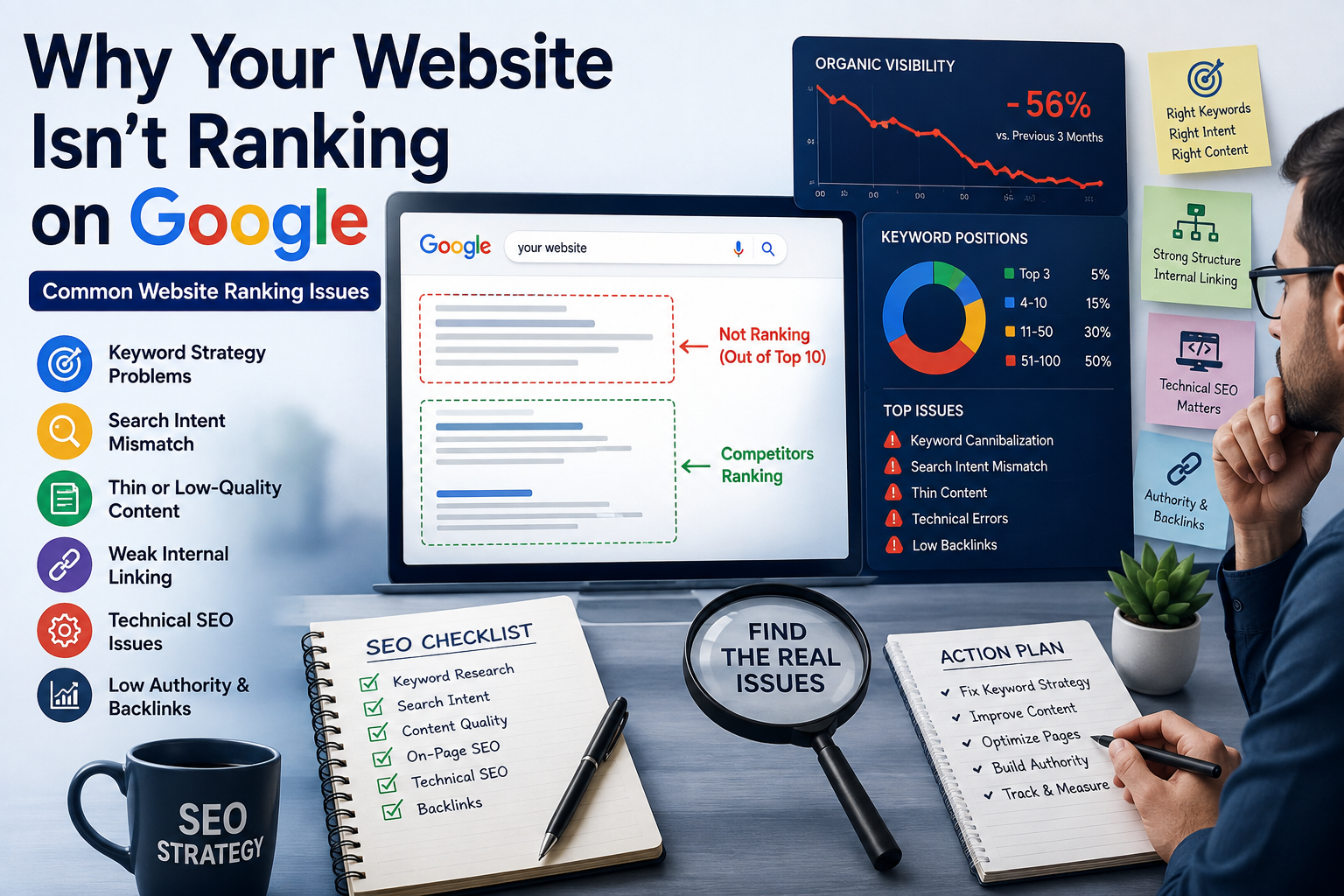
If your website isn’t ranking on Google, the problem may not be your content quality alone. Many website ranking issues come from weak keyword targeting, search-intent mismatches, poor content structure, technical SEO problems, or a lack of topical authority.
For marketing and SEO professionals, diagnosing why a website fails to rank requires looking beyond individual keywords. Google evaluates how well a page satisfies a searcher’s needs, how relevant the content is to the query, and how effectively the site demonstrates expertise and authority.
This guide explains the most common website ranking http://digigyapan.inissues, with a particular focus on keyword strategy issues that can prevent otherwise good content from appearing prominently in search results.
What Are the Most Common Website Ranking Issues?
The most common website ranking issues include targeting overly http://digigyapan.incompetitive keywords, choosing keywords that don’t match search intent, keyword cannibalization, thin or outdated content, weak topical coverage, poor internal linking, technical SEO problems, and insufficient authority.
Before making major changes, identify exactly where the problem occurs. Is the page not indexed? Is it indexed but ranking beyond the first few pages? Is traffic declining? Or is the page ranking for irrelevant keywords?
Each situation requires a different SEO solution.
1. Are You Targeting the Wrong Keywords?
One of the biggest reasons a website isn’t ranking on Google is an ineffective keyword strategy.
SEO teams sometimes choose keywords based primarily on search volume. A keyword with thousands of monthly searches may look attractive, but high volume does not automatically mean high opportunity.
For example, a new website competing for an extremely competitive head term may struggle against established domains. A more specific long-tail keyword can provide a realistic path to visibility.
Instead of asking only:
“How many people search for this keyword?”
also ask:
- What does the searcher actually want?
- What type of pages currently rank?
- How competitive is the query?
- Does the keyword match the site’s expertise?
- Can the business provide a better answer than existing results?
- Does the keyword have commercial or informational value?
A strong keyword strategy balances relevance, search intent, competition, business value, and ranking potential.
How Do You Choose Better Keywords for SEO?
Start by creating keyword groups around a specific topic rather than assigning one isolated keyword to every page.
For each target topic, identify:
- A primary keyword.
- Closely related secondary keywords.
- Long-tail variations.
- Question-based queries.
- Synonyms and semantic concepts.
- Commercial variations where relevant.
This approach helps search engines understand the overall subject of the page while giving users comprehensive information.
2. Does Your Content Match Search Intent?
Even if you target the right keyword, your page may fail to rank because it doesn’t satisfy http://digigyapan.insearch intent.
Search intent generally falls into four categories:
- Informational: The user wants to learn something.
- Navigational: The user wants to find a specific website or resource.
- Commercial investigation: The user is comparing options before making a decision.
- Transactional: The user is ready to take an action or make a purchase.
Suppose your target keyword is informational but the search results are dominated by detailed guides. Publishing a product page may not satisfy the same intent.
Likewise, if Google consistently ranks service pages for a keyword, publishing a generic 3,000-word article may not be the best strategy.
How Can Search Intent Affect Website Rankings?
Analyze the current search results before creating or optimizing content.
Look at:
- Content formats ranking in the top results.
- Common topics covered by competitors.
- Search-result titles and descriptions.
- Featured snippets and other SERP features.
- Whether results are guides, product pages, category pages, videos, or tools.
- The depth and freshness of ranking content.
Your objective isn’t to copy the current results. It’s to understand what Google appears to believe users want and then create a page that satisfies that need better.
3. Are You Targeting One Keyword Across Too Many Pages?
Keyword cannibalization is another common cause of website ranking issues.
Cannibalization happens when multiple pages on the same website target essentially the same search topic and compete for visibility.
For example, a site might have separate pages targeting:
- SEO keyword research
- Keyword research for SEO
- Best SEO keyword research
- How to do SEO keyword research
If these pages have substantially overlapping purposes, Google may struggle to determine which URL should rank.
How Do You Fix Keyword Cannibalization?
First, identify pages competing for the same keyword or search intent.
Then determine whether each page has a genuinely different purpose.
Possible solutions include:
- Consolidating overlapping pages.
- Redirecting redundant URLs.
- Reworking keyword targeting.
- Differentiating search intent.
- Improving internal links to the preferred page.
- Updating title tags and headings.
- Using canonicalization where appropriate.
Don’t automatically merge every page targeting related keywords. Closely related keywords can legitimately rank through different pages when they represent different search intents.
4. Are Your Keywords Too Competitive?
Another reason your website isn’t ranking is that your keyword targets may be unrealistic for the site’s current authority.
A newer or less authoritative website may have difficulty competing immediately for highly established head terms.
This doesn’t mean you should avoid competitive keywords forever. Instead, build a progression.
Start with relevant, specific queries where the site has a realistic opportunity to earn visibility. As topical authority and authority signals develop, gradually pursue more competitive terms.
What Keywords Should a New Website Target?
New websites can often benefit from highly relevant long-tail keywords with clear search intent.
For example, instead of targeting:
“SEO”
a more focused strategy might target:
“how to identify keyword strategy issues in SEO”
or:
“why website pages aren’t ranking for target keywords.”
Long-tail queries typically have lower search demand individually, but they can be easier to target and may attract visitors with more specific needs.
5. Is Your Content Too Thin or Too Narrow?
Creating a page for every possible keyword isn’t necessarily an effective SEO strategy.
If each article provides only a short answer with little original value, the site may develop a large collection of shallow pages.
Modern SEO requires thinking in terms of topics and user needs, not simply keyword repetition.
A strong page should answer the important questions surrounding its primary topic and provide useful context.
For example, an article about website ranking issues could address:
- Keyword targeting.
- Search intent.
- Content quality.
- Keyword cannibalization.
- Internal linking.
- Technical SEO.
- Indexing.
- Backlinks and authority.
- Content freshness.
- SERP competition.
How Much Content Does a Page Need to Rank?
There is no universal word count that guarantees rankings.
A page should be as comprehensive as necessary to satisfy the search intent without adding unnecessary information.
A 1,000-word article can outperform a 5,000-word article if it provides a clearer, more useful answer.
Focus on content completeness rather than arbitrary word counts.
6. Are You Overusing Your Primary Keyword?
Keyword stuffing can make content less readable and does not create a strong SEO strategy.
Repeating website ranking issues excessively throughout an article can produce awkward writing without improving its usefulness.
Instead, build semantic relevance naturally.
Use:
- Primary keywords.
- Long-tail variations.
- Related concepts.
- Synonyms.
- Question-based queries.
- Entity-related terminology.
- Natural language.
The goal is to demonstrate topical relevance while writing primarily for humans.
How Often Should You Use a Keyword in SEO Content?
There is no universal keyword-density percentage that guarantees a ranking.
Rather than forcing a specific density, use the primary keyword where it naturally supports relevance:
- Page title.
- Introduction.
- Relevant H2/H3 headings.
- Body copy.
- Image context where appropriate.
- Meta title and description where appropriate.
- FAQ content when genuinely relevant.
Avoid inserting keywords simply to reach a numerical target.
7. Are You Ignoring Long-Tail Keywords?
Long-tail keywords can reveal specific problems and opportunities that broad keyword research misses.
For this topic, useful long-tail keyword opportunities include:
- why my website is not ranking on Google
- why my website isn’t ranking for keywords
- how to fix website ranking issues
- common SEO keyword strategy mistakes
- why new websites don’t rank on Google
- how to improve keyword targeting for SEO
- why pages are not ranking despite good content
These queries provide insight into the questions users actually ask.
Instead of creating seven thin articles for seven variations, determine whether one comprehensive resource can satisfy multiple closely related searches.
8. Is Your Internal Linking Supporting Your Keyword Strategy?
Internal links help search engines understand relationships between pages.
They also distribute authority throughout a website and help users discover related resources.
If a page is important but receives almost no internal links, you may be sending weak signals about its importance within the site’s architecture.
Build topic clusters where appropriate.
For example:
Pillar page:
SEO Keyword Strategy
Supporting pages:
- Keyword Research Guide
- Search Intent Guide
- Long-Tail Keyword Strategy
- Keyword Cannibalization
- Content Optimization
- Competitor Keyword Analysis
Link related pages together using descriptive, natural anchor text.
9. Are You Measuring Rankings Correctly?
Sometimes the website isn’t actually experiencing a ranking problem. The measurement strategy may be the problem.
Search results can vary based on location, device, personalization, search features, and query interpretation.
Don’t evaluate SEO performance using one keyword position alone.
Track broader indicators such as:
- Organic clicks.
- Organic impressions.
- Ranking keyword coverage.
- Click-through rate.
- Conversions from organic traffic.
- Landing-page performance.
- Visibility across topic clusters.
- Changes in non-brand search traffic.
Why Is My Website Ranking but Getting No Traffic?
A page can rank for keywords but receive little traffic when the queries have low demand, the page ranks too low, or the search-result presentation doesn’t attract clicks.
Review the actual queries generating impressions.
You may discover that the page ranks for unexpected terms rather than the keywords you originally targeted. That information can guide your next optimization cycle.
10. Have You Compared Your Content With the Actual SERP?
Your competitors aren’t just other businesses. In SEO, the search results themselves provide valuable competitive intelligence.
Perform a SERP analysis for your priority keywords.
Compare your page with ranking pages for:
- Search intent.
- Topic coverage.
- Content format.
- Depth.
- Original research.
- Examples.
- Visual content.
- Internal links.
- External references.
- Page experience.
- Content freshness.
The goal is not to produce a longer version of every competitor page.
Instead, identify content gaps and opportunities to create a substantially more useful result.
Step 2: Review Keyword Targeting
Check whether the primary keyword is relevant, achievable, and aligned with search intent.
Step 3: Analyze the SERP
Study what Google currently rewards for the target query.
Step 4: Evaluate Content
Identify missing information, outdated sections, weak explanations, and opportunities to provide unique value.
Step 5: Check Internal Competition
Look for other pages targeting the same topic or intent.
Step 6: Improve Site Architecture
Strengthen internal links and topic relationships.gs?
There is no fixed timeframe. Results depend on factors such as competition, site history, authority, content quality, technical health, and the scale of changes made. Monitor meaningful trends rather than expecting immediate movement after every update.
Should I create separate pages for similar keywords?
Not always. If multiple keywords have the same search intent, one comprehensive page may be more effective than several overlapping pages. Create separate pages when the keywords represent genuinely different user needs or search intents.
Final Takeaway
When a website isn’t ranking on Google, the solution isn’t always “write more content.”
Start with the fundamentals: target the right keywords, understand search intent, avoid keyword cannibalization, build topical depth, strengthen internal linking, and make sure your pages provide a better answer to the searcher’s needs.
For SEO professionals, the most valuable shift is to stop treating rankings as a keyword-counting exercise. A successful keyword strategy connects search demand with intent, content, site architecture, and business objectives.
Diagnose the specific website ranking issues first. Then make focused changes, measure the results, and continue refining the strategy based on actual search performance.
Breadcrumb Title
Website Ranking Issues
Primary Keyword
Website ranking issues
Long-Tail Keywords
- Why my website is not ranking on Google
- Why my website isn’t ranking for keywords
- How to fix website ranking issues
- Common SEO keyword strategy mistakes
- Why new websites don’t rank on Google
- How to improve keyword targeting for SEO
- Why pages are not ranking despite good content